Introduction
If you’re using Xiaohongshu (XHS) to get students, this is something you cannot skip.
A lot of teachers are honestly a little nervous about this platform—and for good reason.
You’ve probably heard stories of teachers:
- Getting their reach completely cut off
- Having posts suddenly stop performing
- Or even getting their accounts restricted or banned
And yes… this has happened to teachers before.
The frustrating part?
Most of the time, they didn’t even realize they were doing anything wrong.
That’s exactly why this matters.
This post is here to break down the Terms & Conditions in a way that actually makes sense for online English teachers—so you can grow your account without constantly worrying about getting flagged, restricted, or kicked off the platform.
Because when you understand how XHS works, you stop guessing—and start posting with confidence.
Why Xiaohongshu Rules Matter for Teachers
XHS is not like Instagram or Facebook.
It’s built around:
- Trust
- Authentic experiences
- Helpful content
That means the platform is constantly filtering out:
- Overly promotional posts
- Misleading claims
- Content that feels like an ad
👉 If your content doesn’t align with this, your reach will drop—fast.
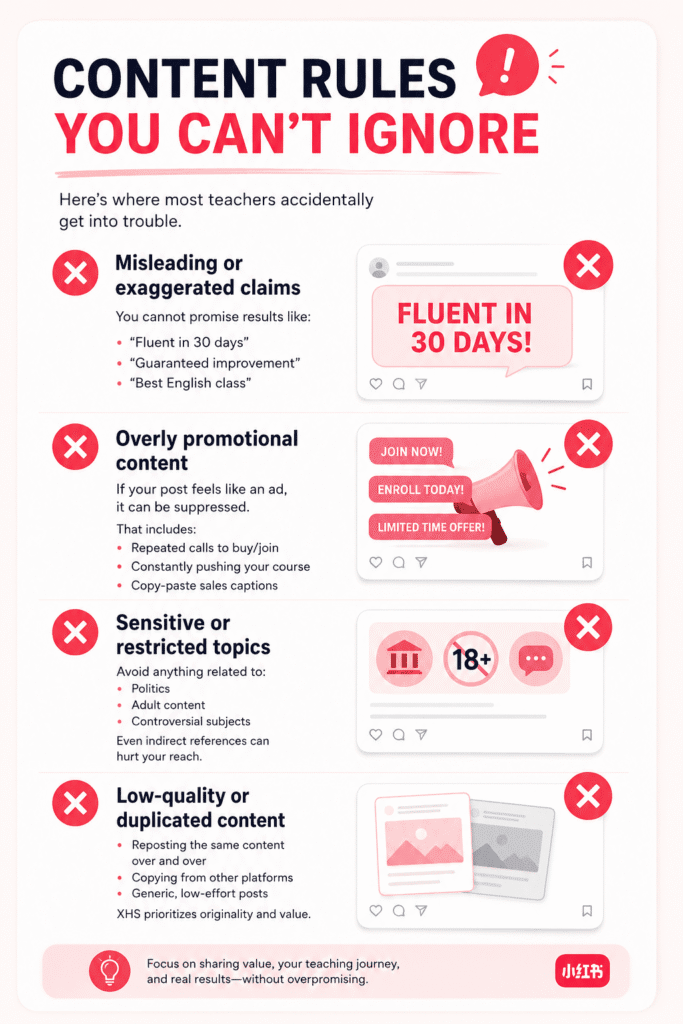
Content Rules You Can’t Ignore
Here’s where most teachers accidentally get into trouble.
❌ Misleading or exaggerated claims
You cannot promise results like:
- “Fluent in 30 days”
- “Guaranteed improvement”
- “Best English class”
Even if you know your program works, XHS flags this as misleading.
❌ Overly promotional content
If your post feels like an ad, it can be suppressed.
That includes:
- Repeated calls to buy/join
- Constantly pushing your course
- Copy-paste sales captions
❌ Sensitive or restricted topics
Avoid anything related to:
- Politics
- Adult content
- Controversial subjects
Even indirect references can hurt your reach.
❌ Low-quality or duplicated content
- Reposting the same content over and over
- Copying from other platforms
- Generic, low-effort posts
XHS prioritizes originality and value.
What Happens If You Break the Rules
This isn’t just about getting a post deleted.
XHS penalties can include:
- Reduced reach (shadowban)
- Posts not appearing in search
- Comment or messaging restrictions
- Temporary suspension
- Permanent account ban
And here’s the tricky part:
👉 You won’t always be told exactly what you did wrong.
Promotion & Selling: What’s Allowed (and What’s Not)
This is where you need to shift your mindset.
What DOES work:
- Teaching mini-lessons
- Sharing student progress stories
- Showing your teaching style
- Answering parent questions
What DOESN’T work:
- “Join my class now” in every post
- Aggressive selling
- Dropping links everywhere
⚠️ Leading Users Off the Platform (What the Terms ACTUALLY Say)
This is one of the biggest concerns teachers have—and one of the most misunderstood parts of the Terms & Conditions.
First, here’s what’s important:
👉 The terms do NOT say you can’t share your WeChat.
There is no direct rule banning sharing contact info in messages.
📜 What the Terms DO say
Now—this is important.
The official terms are written in Chinese legal language, and translations vary slightly. So instead of pretending there’s one perfect English sentence, here are the accurate translated phrases/meanings used in the Terms (what you’ll actually see reflected in enforcement):
🧾 “Improper Traffic Diversion”
Official meaning (translated):
Users must not engage in behavior that improperly directs traffic or users away from the platform for commercial purposes.
👉 This is the core rule behind WeChat concerns.
🧾 “Disrupting Platform Order / User Experience”
Official meaning (translated):
Users must not engage in activities that interfere with the normal operation of the platform or affect other users’ experience.
👉 If you’re aggressively pulling users off XHS, this can fall under this.
🧾 “Spam / Mass Solicitation”
Official meaning (translated):
Users must not send repetitive, bulk, or unsolicited promotional information.
👉 This is where copy/paste WeChat messages become risky.
🧾 “Excessive or Improper Promotion”
Official meaning (translated):
Users must not publish excessive marketing or advertising content that violates platform rules.
👉 Too many sales-driven posts = reduced reach.
⚠️ What This Means (Real-Life Translation)
Let’s simplify all of that into what actually happens on the platform:
- Moving users off-platform naturally → ✅ OK
- Using XHS mainly as a funnel → ❌ Risky
- One-on-one conversations → ✅ OK
- Mass outreach or pushing contact info → ❌ Flagged behavior
💬 Messaging vs. Public Posting
✅ In Private Messages (DMs):
Generally allowed:
- Sharing your WeChat ID
- Continuing a conversation off-platform
As long as:
- The user has shown interest
- It’s part of a real conversation
- You’re not mass messaging
❌ In Public Posts/Comments:
Risky behavior includes:
- Posting your WeChat ID directly
- Repeating it across posts
- Telling everyone to add you immediately
👉 This is where reach suppression happens most.
⚠️ What Gets Accounts Flagged Fast
- Copy/paste messaging your WeChat to everyone
- Sending unsolicited contact info
- Immediately pushing users off-platform
- Using XHS purely as a lead funnel
✅ How to Do This Safely (and Still Get Students)
- Build trust through your content first
- Let users initiate interest
- Move to DMs naturally
- Then transition off-platform when it makes sense
💡 Safe Messaging Example
Instead of:
❌ “Add my WeChat: ___”
Try:
✅ “I can share more details on WeChat if that’s easier 😊”
🧠 The Rule to Remember
👉 If it feels like a conversation → you’re safe
👉 If it feels like a shortcut to sell → you’re at risk
😬 Still Nervous About Sharing WeChat? (Totally Valid)
A lot of teachers are still hesitant—and honestly, I agree with that hesitation.
If you want to be extra cautious, here are some safer alternatives I recommend:
1. Invest in a Business Account with Advertising
This is the lowest-risk option, but it comes with requirements:
- Costs a few hundred dollars per year
- Requires collaboration with a Chinese resident
- You need a legitimate business entity in your country
👉 If you go this route, XHS gives you a built-in:
“Share WeChat Contact Info” button
This is:
- Platform-approved
- Built into the system
- Considered zero risk
⚠️ Note: This used to be available on regular business accounts, but that has changed recently.
2. Use a Voice Message First
Instead of immediately typing your WeChat ID:
- Send a voice message saying:“I’m going to share my WeChat info with you.”
- Then type your WeChat ID after
👉 Why this helps:
- Feels more natural
- Less like copy/paste spam
- Mimics real conversation behavior
3. Send a Screenshot (My Favorite)
This is one of the safest and most natural-feeling methods:
- Take a screenshot of your WeChat profile/settings
- Circle your WeChat ID
- Send the image in chat
👉 Important:
❌ Do NOT send your QR code
Why?
- QR codes can look more promotional/automated
- Screenshots feel more personal and conversational
💡 Final Thought on This
You don’t have to rush moving people off-platform.
In fact, the more natural you make it, the better your results will be anyway.
⚠️ “Be Careful” Warning Messages (Don’t Panic)
This is something that really scares teachers—so let’s clear it up.
After you share your WeChat contact info (or sometimes even after certain conversations), you may see a message pop up in your chat.
It usually says something like:
- “Be careful when communicating off-platform”
- “Be aware of scams”
- Or a general warning about safety
👉 And yes… this message can look intimidating.
What This Message Actually Means
This does NOT automatically mean your account is flagged or in trouble.
What it DOES mean:
- The system detected that contact information may be being shared
- It’s triggering a general safety warning
- It’s meant to protect users—not punish you immediately
⚠️ When It CAN Become a Problem
While one warning isn’t a big deal, repeated triggers can be:
- A sign the system is noticing patterns
- Potentially lead to reduced reach or restrictions over time
👉 So it’s not dangerous on its own—but it’s something to be aware of.
✅ How to Avoid These Warnings
If you use the safer methods mentioned above, you’ll typically avoid triggering these messages altogether:
- Using a business account contact button
- Sending a voice message first
- Sharing your info via screenshot (instead of typing it directly)
👉 These methods feel more natural to the platform—and are less likely to trigger system alerts.
🧠 The Bottom Line
- One warning message = not a problem
- Repeated triggers = something to avoid
- Natural conversations = safest approach
👉 XHS rewards help first, sell later.
Data, Privacy, and Platform Control
By using XHS, you agree that:
- The platform can remove your content anytime
- They control how your content is distributed
- They collect user data (like most platforms)
This means you don’t own your audience—you’re building on rented space.
How to Stay Safe and Still Grow Your Teaching Business
Here’s how to actually win on XHS without risking your account:
1. Teach in every post
Give value first. Think:
- Vocabulary tips
- Writing help
- Speaking practice ideas
2. Show real moments
- Clips from your classes
- Student work (with permission)
- Behind-the-scenes teaching
3. Use soft calls to action
Instead of pushing sales, try:
- “Message me for details”
- “Comment if you want to learn more”
4. Stay consistent
Consistency builds trust—and trust is everything on XHS.
Common Mistakes Online Teachers Make on XHS
Let’s call these out clearly:
- Posting like it’s Instagram
- Being too salesy too fast
- Making big promises about results
- Not engaging with comments
- Ignoring what parents actually care about
If you fix just these, your results can change fast.
Conclusion
Xiaohongshu is one of the best platforms right now for getting online English students—but only if you play by the rules.
The biggest shift?
👉 Stop trying to sell.
👉 Start building trust.
When you do that, everything changes.
What’s Next?
If you want help turning XHS into a consistent stream of students, join us in Teacher Boss Society. There are tons of trainings to help you grow your business to the next level and enroll new students using tools like XHS.
Leave a Reply