

To teach word formation effectively, start with the sentence, not a list of suffixes. Help students identify the part of speech a gap requires, choose the appropriate word-family member, and check whether the meaning needs to change.
This approach gives learners a reason for their answers. It is especially useful for B2 First, also known as FCE, preparation, but the foundations can begin earlier. Understanding how success, succeed, successful, and successfully relate to one another is a vocabulary skill, not just an exam technique.
Key Takeaways
- Teach students to analyze sentence structure before changing the supplied base word.
- Check grammatical function, word-family form, and sentence meaning before accepting an answer.
- Build word families gradually, addressing spelling changes and negative prefixes in context.
- Require explanations and independent writing to move beyond recognition and guessing.
[ez-toc]
What Does Word Formation Involve?
In ESL word formation exercises, students use a supplied base word to produce a related form that fits a sentence. That may involve changing the part of speech, adjusting the spelling, or adding a prefix that changes the meaning.
- Changing grammatical function: achieve becomes the noun achievement.
- Choosing a related adjective: create becomes creative.
- Forming an adverb: dramatic becomes dramatically.
- Expressing the opposite: clear becomes unclear.
The teaching challenge is that understanding a sentence does not automatically mean a student can analyze its structure. A learner might recognize the correct answer without knowing why it belongs there. That familiarity can help with known words, but it offers less support when an unfamiliar form appears.
The goal is to make the reasoning transferable: students should be able to explain both the grammatical fit and the meaning of their answer.
Build the Foundations Before Exam Practice
Students do not need to wait until B2 to learn the terms noun, verb, adjective, and adverb. Depending on age and readiness, these labels can become part of lessons at A2 or B1.
Introduce them through words and sentences students already understand. The terminology should help them describe what a word does, rather than become another disconnected set of definitions.
Before moving into demanding word formation tasks, check whether students can:
- Recognize a noun in a familiar sentence.
- Identify an adjective that describes a noun.
- Distinguish a verb from related noun or adjective forms.
- Notice the words immediately before and after a gap.
These foundations let you ask focused questions during practice instead of supplying the answer yourself.
A Three-Check Routine for Word Formation Questions
Teach students to work through the same sequence each time: sentence structure, word form, then meaning. Initially, model the process aloud. Later, ask learners to explain it with less prompting.
1. Identify the grammatical job of the missing word
Temporarily cover the supplied base word. Ask students to examine the gap and its surroundings before trying to transform anything.
For example:
We must reach a final ______ today.
Base word: decide
The article a and adjective final help identify the missing word as a noun. Only after establishing that should students consider the noun form of decide: decision.
Useful teacher prompts include:
- Which words appear immediately before the gap?
- What follows the gap?
- Does the missing word describe something?
- Which part of speech would fit this position?
The important distinction is between identifying a grammatical role and remembering a particular word. A student may know that a noun is required but not yet know the noun form. That is a vocabulary gap, not the same problem as failing to recognize the sentence structure.
2. Select the appropriate member of the word family
Once students know the required part of speech, reveal or return to the base word.
Consider this example:
The team presented several ______ solutions.
Base word: create
The gap describes the noun solutions, so it requires an adjective. The appropriate form is creative.
Do not accept the completed word as the only evidence of understanding. Ask the student to connect the answer to its function: creative is the adjective describing the solutions.
This keeps suffix knowledge attached to sentence use. Remembering an ending is helpful, but students also need to know when that form is appropriate.
3. Check the meaning of the complete sentence
A word can fit grammatically while failing to express the intended meaning.
For example:
Several learners misunderstood the task because the directions were ______.
Base word: clear
Both clear and unclear are adjectives. However, the misunderstanding points toward unclear as the intended answer.
Ask students to reread the entire sentence after filling the gap. They should check whether the result makes sense, rather than stopping as soon as they have found the correct part of speech.
Grammar narrows the options; context helps determine which option is needed.
Teach Word Families Gradually, Not as Huge Lists
Word-family work becomes more useful when students see related forms together. Instead of treating each form as unrelated vocabulary, show how a familiar word connects to forms with different grammatical jobs.
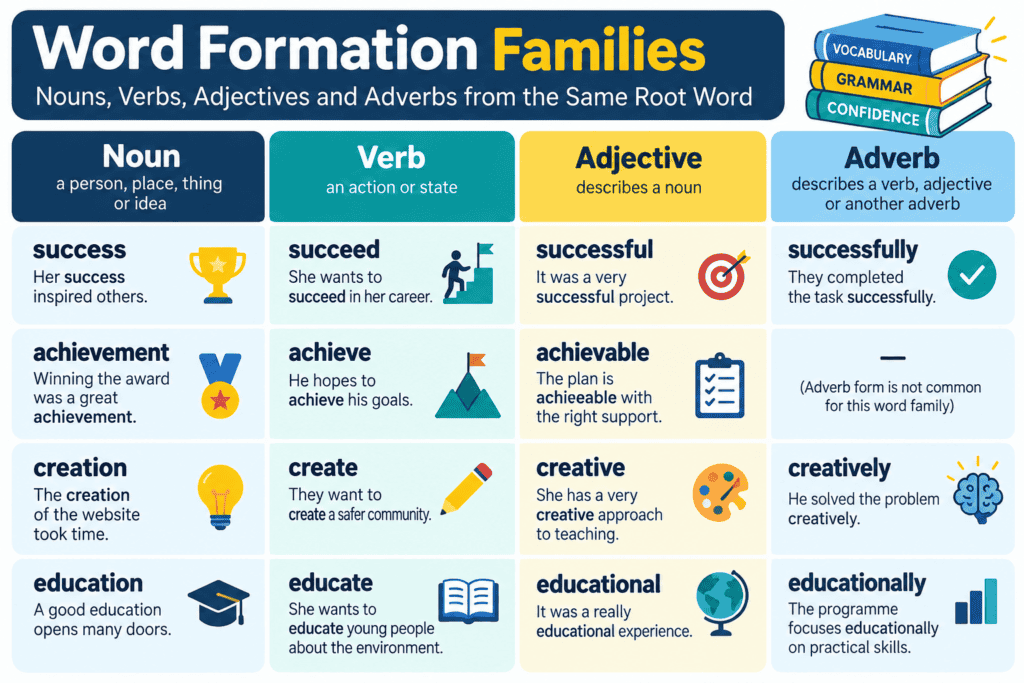
A word-family record can use four labeled categories without requiring a large reference sheet:
- Success family: noun, success; verb, succeed; adjective, successful; adverb, successfully.
- Achieve family: noun, achievement; verb, achieve; adjective, achievable.
- Other useful connections: create and creative; dramatic and dramatically.
Build these records as words arise in lessons. There is no need to introduce every familiar and unfamiliar suffix at once.
It is also fine to leave a category empty. Do not imply that every English word has a straightforward, useful form in all four categories. The record is a way to organize vocabulary, not a requirement to manufacture missing words.
For an additional reference on how English words are built, the Cambridge guide to word formation can support lesson preparation.
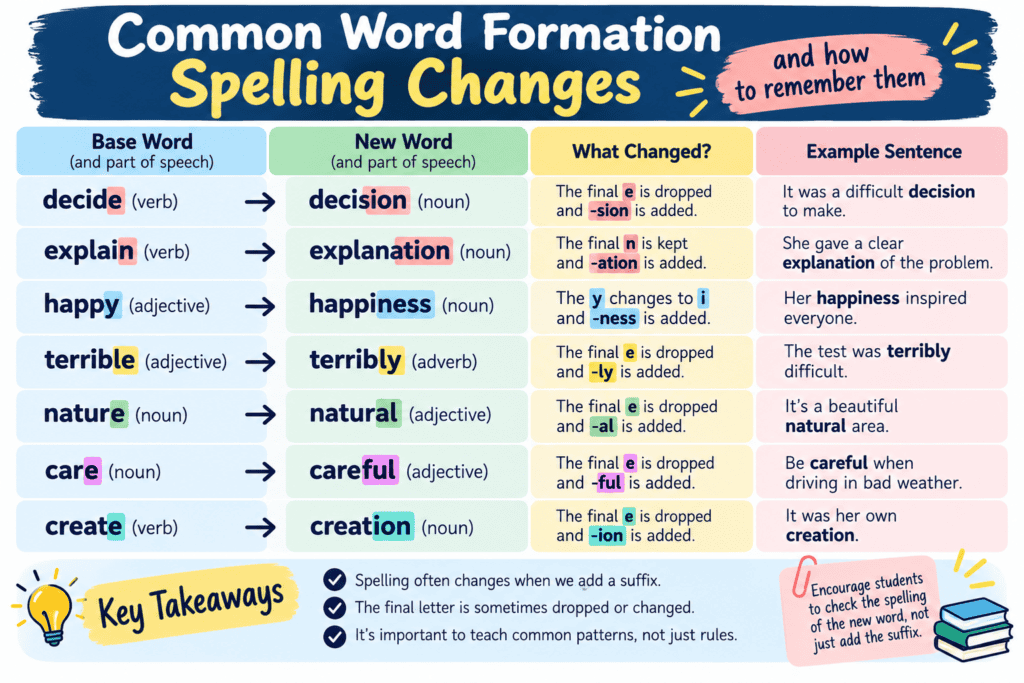
Address spelling changes when they become relevant
Choosing the right word family is not the end of the task. Students also need to notice how the spelling changes.
Useful pairs to examine include:
- decide → decision
- explain → explanation
- terrible → terribly
When a pair appears, pause and have students compare the two forms. Ask them to identify which letters remain, disappear, or change. Return to earlier examples when related spelling patterns appear later.
This keeps spelling instruction connected to words students are actively using, rather than front-loading a long collection of rules.
Teach negative prefixes through meaning and examples
Students may recognize un- readily but be less confident with other negative forms. Include examples such as inaccurate, imperfect, irrelevant, and illiterate.
Useful patterns to notice include:
- im- often occurs before words beginning with p or m.
- il- occurs in negative forms before l.
- ir- occurs in negative forms before r.
Present these as helpful patterns, not permission to attach a prefix automatically. Students must first decide whether the sentence needs an opposite meaning, then select the appropriate form.
Word Formation Activities That Develop Independent Thinking
Hide the base word
This activity separates sentence analysis from vocabulary recall.
- Display a sentence with a gap, but keep the base word hidden.
- Ask the student to identify the required part of speech.
- Ask which surrounding words support that choice.
- Reveal the base word and request the appropriate form.
- Check spelling and reread for meaning.
For example, display The exhibition was an unexpected ______. Students first establish that a noun is needed. Then reveal succeed and work toward success.
With no base word visible at first, students cannot begin by experimenting randomly with endings.
Complete a word-family record together
Choose one familiar word and provide the labels noun, verb, adjective, and adverb. Have students add the forms they already know, then work together on the missing ones.
Keep the focus on relationships and grammatical roles. Empty categories are acceptable, and students should understand why they do not need to fill every space.
Require an explanation, then reduce support
At first, guide learners with specific prompts about articles, nouns, descriptive words, and meaning. As they become more confident, replace those prompts with a broader request to explain their choice.
A useful explanation should identify:
- The sentence clue: the surrounding language that signals the grammatical role.
- The chosen form: the related word that performs that role.
- The meaning check: whether a negative or opposite form is necessary.
This reveals more than a correct answer alone. It shows whether students can apply the process when the context changes.
Move from gap fills into writing
Give students opportunities to use related forms in their own writing, not only recognize them in exercises. Writing homework can bring the forms back into active use.
For example, ask learners to use members of a word family studied in class. During feedback, discuss whether each form performs the intended grammatical job and communicates the intended meaning.
Common Teaching Mistakes to Avoid
- Accepting an unexplained correct answer. The student may have recognized a familiar phrase without understanding its structure.
- Starting with suffix memorization. Students still need to identify what kind of word the sentence requires.
- Teaching too many forms at once. Build word families gradually through relevant encounters.
- Skipping the meaning check. The correct part of speech does not guarantee the correct answer.
- Forcing every word into four categories. Leave gaps rather than suggesting every family has four convenient forms.
- Using only practice tests. Targeted lessons let students examine patterns directly instead of waiting for them to appear.
- Keeping all the reasoning with the teacher. Gradually transfer the explanation and decision-making to the learner.
What Successful Word Formation Teaching Looks Like
A useful sign of progress is not simply that students complete more gaps correctly. It is that they can explain the evidence behind their choices and apply the same reasoning to less familiar examples.
Keep the routine consistent: analyze the sentence, select the related form, inspect the spelling, and confirm the meaning. Combine that process with gradual word-family building and opportunities to write.
For B2 First preparation, Florentis Learning offers four word formation lessons covering nouns, adjectives, negative prefixes, and verbs and adverbs within its FCE Test Prep collection, part of the complete classroom curriculum.
Post your Comment About This Product