
If you’re thinking about starting your first group class, one of the biggest decisions you’ll make is whether to offer an ongoing class or a fixed-date class.
Both models can help you earn more, reach more students, and create a stronger teaching business. However, the best choice depends on your teaching style, your students, and your long-term goals.
In this article, we’ll compare ongoing and fixed-date group classes, explore the pros and cons of each, and help you determine which model is the best fit for your business.
What Is an Ongoing Group Class?
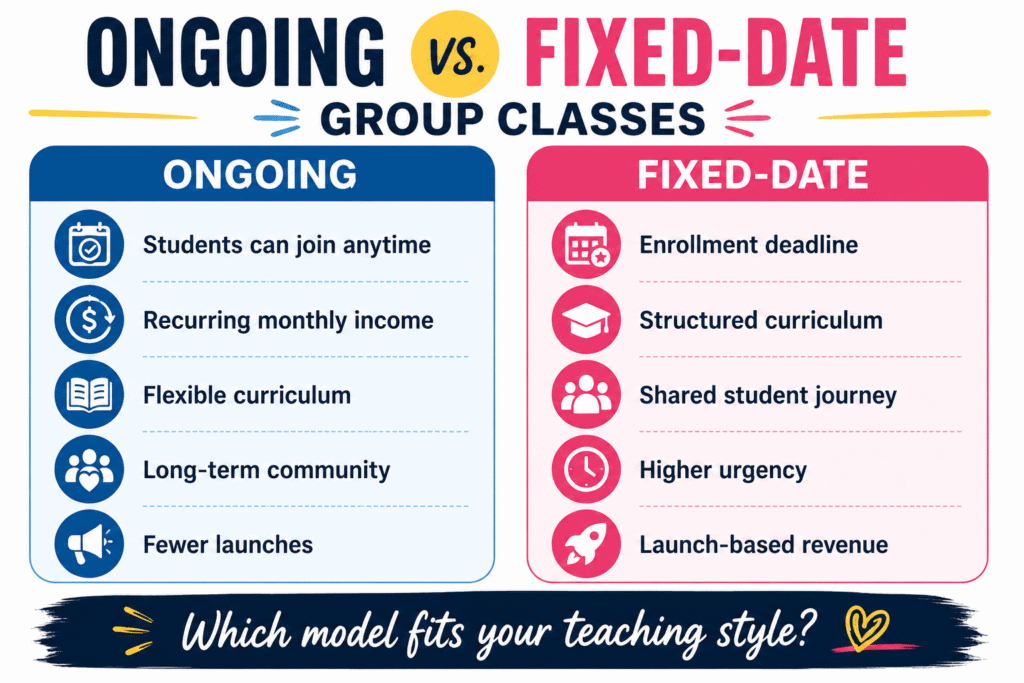
An ongoing group class allows students to join at any time. New students enroll whenever space becomes available, and classes continue indefinitely.
Many conversation clubs, reading groups, and skills-based classes operate using this model.
For example, an ESL conversation class may meet every Tuesday at 6:00 PM. Students can join this week, next month, or six months from now, provided there is room in the class.
Pros of Ongoing Group Classes
Predictable Recurring Income
Because students remain enrolled from month to month, ongoing classes can create steady and reliable income.
Instead of constantly launching new classes, you focus on retaining students and filling occasional openings.
Less Frequent Marketing
Once a class is established, you only need to market available spots rather than filling an entire class from scratch each time.
Strong Community Building
Students often stay together for months, forming friendships and becoming comfortable participating in class discussions.
Easier Long-Term Scheduling
You can teach the same class each week without redesigning curriculum or planning frequent launches.
Cons of Ongoing Group Classes
Student Levels Can Vary
When students join at different times, skill levels and experience may not always match perfectly.
Curriculum Must Be Flexible
You’ll need lessons that allow students to enter the class without feeling lost.
Student Turnover Requires Attention
When students leave, you’ll need a system for attracting and enrolling new students to replace them.
What Is a Fixed-Date Group Class?
A fixed-date group class starts and ends on specific dates. Students enroll before the class begins, complete the program together, and finish at the same time.
For example, you might offer an eight-week writing course that begins on September 1 and ends on October 27.
Once the course ends, students can either join another program or wait for the next enrollment period.
Pros of Fixed-Date Group Classes
Easier Curriculum Planning
Every student starts at the same point and progresses through the material together.
This makes it easier to build lessons that increase in difficulty over time.
Stronger Student Accountability
Students often feel more committed when they’re part of a program with a clear beginning and end.
Natural Enrollment Deadlines
Enrollment deadlines create urgency and can make marketing easier.
Parents are often more likely to enroll when they know registration closes on a specific date.
Better for Transformational Results
If your goal is to help students achieve a specific outcome, a fixed-date class often works best.
Examples include:
- Essay writing bootcamps
- Reading intervention programs
- IELTS preparation
- Grammar mastery courses
- Public speaking programs
Cons of Fixed-Date Group Classes
More Frequent Launches
Every new class requires promotion and enrollment efforts.
Income Can Be Less Predictable
Revenue often arrives in waves during enrollment periods rather than consistently throughout the year.
More Administrative Work
You’ll spend time managing registration periods, onboarding students, and preparing for each new cohort.
Which Teachers Should Choose Ongoing Classes?
An ongoing model may be a good fit if:
- You want consistent monthly income.
- You prefer teaching the same students long-term.
- You teach discussion-based subjects.
- You want fewer launches and promotions.
- You already have a steady stream of interested students.
Popular examples include:
- ESL conversation clubs
- Book clubs
- Reading circles
- Ongoing writing groups
- Homework help programs
Which Teachers Should Choose Fixed-Date Classes?
A fixed-date model may be a good fit if:
- You teach a structured curriculum.
- Students need to progress through lessons in order.
- You enjoy launching new programs.
- You want to create urgency around enrollment.
- You teach outcome-based classes.
Popular examples include:
- Writing workshops
- Test preparation courses
- Beginner language programs
- Math intervention classes
- Summer camps
A Third Option: Start with a Small Cohort
If you’re launching your very first group class, a fixed-date cohort can be an excellent starting point.
Because all students begin together, you’ll have fewer moving parts to manage while learning how to facilitate a group environment.
Once you’ve gained confidence and refined your curriculum, you may decide to convert the class into an ongoing program.
Many successful online teachers use this exact progression:
- Launch a small fixed-date group.
- Gather feedback and testimonials.
- Refine the curriculum.
- Transition to an ongoing model for recurring revenue.
Final Thoughts
There is no single “best” group class model.
An ongoing class offers recurring income, community, and simplicity. A fixed-date class provides structure, urgency, and clear outcomes.
The best choice depends on your teaching style, your students, and the type of learning experience you want to create.
If you’re launching your very first group class, don’t get stuck trying to find the perfect model. Choose one, enroll a few students, and get started.
Your first group class doesn’t need to be perfect—it just needs to begin.
If you’d like support as you build and launch your group program, join the Teacher Boss Society, where online educators learn how to create sustainable businesses, attract students, and increase their income through offers like group classes.
And if you’re ready to take action, be sure to join our Create a Group Challenge, which goes live on June 29, 2026. During the challenge, you’ll get step-by-step guidance to help you choose your group class model, design your offer, and confidently launch your first group program.
The best time to start is now—and we’d love to help you make it happen.
Leave a Reply