

You know you should be posting consistently.
You’ve heard that social media can help you find students, grow your email list, sell teaching resources, build an audience, and eventually create income outside of your teaching hours.
There’s just one problem:
What are you supposed to post about?
If you’ve ever opened Instagram, Facebook, TikTok, YouTube, or your blog with every intention of creating something — only to stare at a blank screen for 20 minutes — you’re definitely not alone.
One of the biggest misconceptions teachers have about content creation is that every post needs to be completely original, incredibly educational, beautifully designed, and worthy of going viral.
It doesn’t.
Your content simply needs to be useful, interesting, relatable, or helpful to the person you want to reach.
And once you understand that, finding things to post becomes much easier.
Whether you’re an online tutor, ESL teacher, homeschool educator, TPT seller, course creator, teacher-turned-entrepreneur, or someone building an education business, here are 50 teacher content ideas you can use when you have absolutely no idea what to post.
Why Teachers Should Create Content in the First Place
Before we get into the ideas, it helps to understand why you’re creating content.
Posting just because someone told you that you “need to be on social media” gets exhausting very quickly.
Your content should have a purpose.
For teachers building an online business, content can help you:
- Find new students
- Establish yourself as an expert
- Build trust with parents or potential clients
- Grow an email list
- Sell digital products
- Promote courses or memberships
- Drive traffic to your website
- Grow a YouTube channel
- Build an audience you actually own
- Create additional income streams
You also don’t need millions of followers.
If 500 people follow you and 100 of them are exactly the type of people who might eventually hire you, purchase your resources, or recommend you to someone else, that can be far more valuable than having 50,000 random followers.
The goal isn’t necessarily to become an influencer.
The goal is to become known for something.
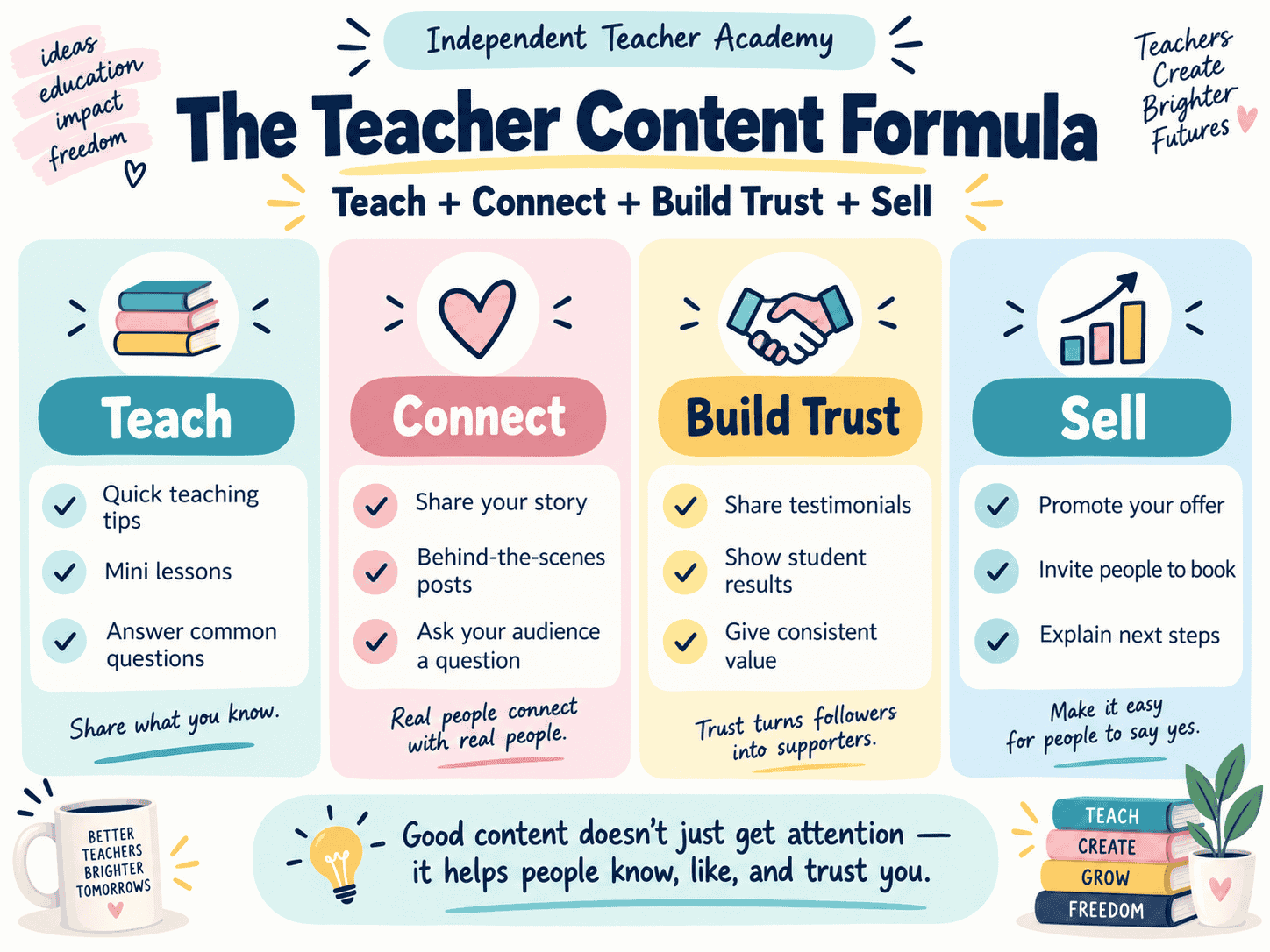
50 Content Ideas for Teachers
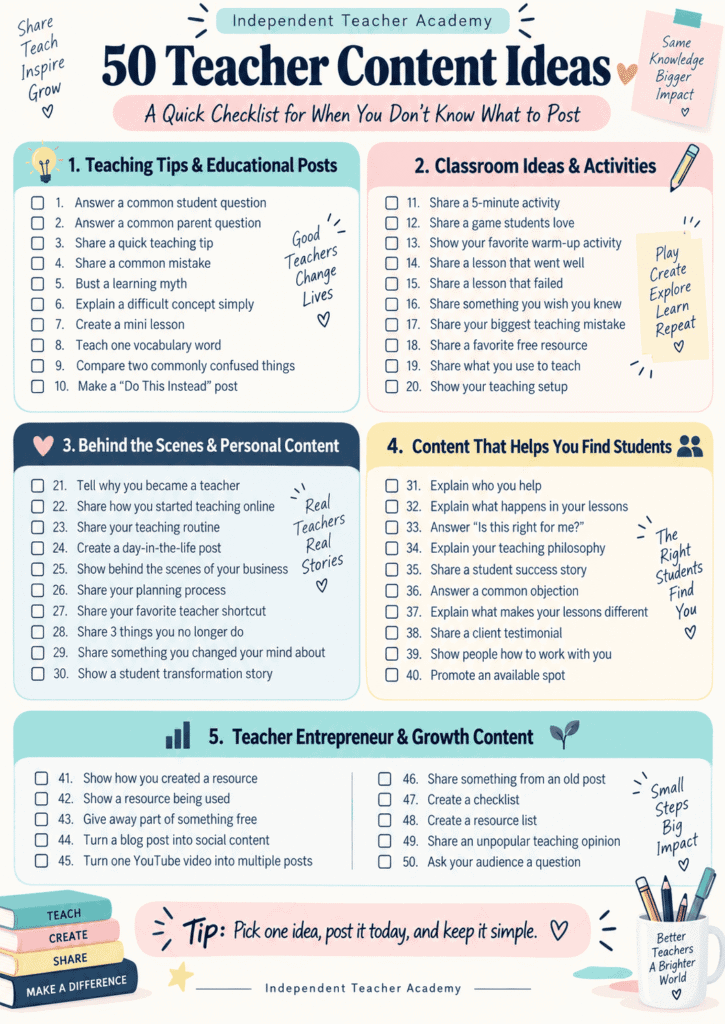
1. Answer a Question Students Ask You All the Time
Think about the questions you answer repeatedly.
If one student is confused about something, there are probably hundreds of other people searching for the same answer.
Turn the question into a post, Reel, TikTok, YouTube video, email, or blog article.
2. Answer a Question Parents Frequently Ask
If you teach children, parents are one of your most important audiences.
Common questions about homework, reading, language development, tutoring, practice, or learning expectations can all become content.
3. Share a Quick Teaching Tip
Simple tips work incredibly well because they’re easy to consume.
For example:
“One thing I always do when a student is struggling with…”
Then explain your strategy.
4. Share a Common Mistake
Mistake-based content is naturally clickable.
Try:
- 5 mistakes beginner English learners make
- 3 mistakes parents make when practicing reading at home
- The biggest mistake new online teachers make
- Why memorizing vocabulary lists doesn’t always work
5. Bust a Myth About Learning
Education is full of myths.
Pick one and explain why it isn’t completely accurate.
For example:
“You don’t have to speak English perfectly before having conversations.”
6. Show Your Teaching Setup
People love seeing behind the scenes.
Show your classroom, desk, webcam, lighting, whiteboard, teaching props, microphone, books, or online teaching setup.
7. Share What You Use to Teach
Create a post showing your favorite:
- Teaching platform
- Whiteboard
- Headset
- Books
- Apps
- Flashcards
- Games
- Educational websites
These posts can also eventually become affiliate content if the products have affiliate programs.
8. Share Your Favorite Free Teaching Resource
Teachers love free resources.
Highlight a website, printable, tool, app, activity, or educational resource that makes teaching easier.
9. Show a Before-and-After Student Transformation
Be careful about student privacy and always get appropriate permission before sharing identifiable information.
But anonymous transformations can be incredibly powerful.
For example:
“Three months ago this student was afraid to speak English. Now she can hold a five-minute conversation.”
Then explain what helped.
10. Tell the Story of Why You Became a Teacher
People connect with stories.
Talk about why you started teaching, what surprised you about the profession, or how your career changed over time.
11. Tell the Story of How You Started Teaching Online
This is particularly valuable if your audience includes other teachers.
Explain how you found your first student, what equipment you started with, what mistakes you made, and what you would do differently now.
12. Share Your Biggest Teaching Mistake
You don’t always need to present yourself as someone who has everything figured out.
Talking about mistakes makes your content more relatable.
Even better: explain what the mistake taught you.
13. Share Something You Wish You Knew as a New Teacher
Try a hook like:
“If I could go back and tell first-year-teacher me one thing, it would be this…”
14. Explain a Difficult Concept Simply
Take something students commonly struggle with and explain it in the simplest possible way.
These are perfect posts to save and share.
15. Create a Mini Lesson
Teach something in less than five minutes.
Depending on your niche, that might be:
- One grammar rule
- One math strategy
- One pronunciation tip
- One reading strategy
- One science concept
- One study technique
16. Teach One Vocabulary Word
This is especially useful for language teachers.
Include:
- Definition
- Pronunciation
- Example sentence
- Common mistakes
- Similar words
17. Explain the Difference Between Two Commonly Confused Things
Examples:
- Your vs. you’re
- Affect vs. effect
- Present perfect vs. past simple
- Tutoring vs. teaching
- Phonics vs. phonemic awareness
Comparison content performs well because people are often actively searching for the difference.
18. Make a “Do This Instead” Post
Example:
Instead of telling a student to “study harder,” try this…
Then provide something practical.
19. Share a Five-Minute Activity
Teachers and parents love activities that don’t require 30 minutes of preparation.
Bonus points if you can say:
“No printing required.”
20. Share a Game Students Love
Explain the game, what skill it practices, and how to adapt it for different age groups.
21. Show Your Favorite Warm-Up Activity
Teachers are always looking for easy lesson starters.
This could also become a series.
22. Share a Lesson That Went Surprisingly Well
Tell people what you taught, what you tried, and why you think the activity worked.
23. Share a Lesson That Completely Failed
Yes, failed lessons make content too.
Sometimes they make better content.
Explain what happened and what you changed afterward.
24. Share Your Teaching Routine
Show followers what happens:
Before class → During class → After class
This works especially well as a Reel, carousel, TikTok, or vlog.
25. Create a “Day in the Life” Post
These don’t have to be elaborate.
Show:
- Lesson prep
- Teaching
- Lunch
- Administrative work
- Content creation
- Family life
- Running your business
People are naturally curious about what other people do all day.
26. Show What Happens Behind the Scenes of Your Business
If you’re an independent teacher, your job involves far more than teaching lessons.
Show yourself:
- Answering inquiries
- Scheduling students
- Creating lessons
- Sending invoices
- Writing emails
- Updating your website
- Creating content
It also helps potential clients understand the work that goes into your services.
27. Share Your Planning Process
How do you plan lessons?
Do you plan an entire month at once?
Do you customize every lesson?
Do you reuse materials?
Show people.
28. Share Your Favorite Teacher Shortcut
What’s something that saves you time every week?
Teachers LOVE time-saving content.
29. Share Three Things You No Longer Do
Try:
“3 things I stopped doing after teaching for 10 years.”
These posts instantly create curiosity.
30. Share Something You Changed Your Mind About
Maybe you once believed every lesson needed a detailed PowerPoint.
Maybe you thought worksheets were always bad.
Maybe you thought teachers needed fancy equipment to teach online.
Tell people what changed your opinion.
Content Ideas That Help You Find Students
If your content is getting engagement but not turning into inquiries, it may be worth reading The 7 Biggest Mistakes Online Teachers Make When Trying to Get Students. It can help you spot where your marketing message is breaking down.
If your goal is to get more students or clients, not every post should be aimed at other teachers.
This is an important distinction.
A tutoring business that only creates content for tutors may build an audience of thousands of teachers while attracting very few actual students.
You need content for the person who buys your service.
31. Explain Who You Help
If you are not sure who your content should be speaking to yet, start with How to Choose a Niche That Actually Sells. The clearer your niche is, the easier it becomes to create content that attracts the right students.
Be specific.
Instead of:
“I teach English.”
Try:
“I help intermediate English learners become more confident speaking English in professional conversations.”
That gives potential students a reason to pay attention.
32. Explain What Happens During One of Your Lessons
Potential students may have no idea what online tutoring actually looks like.
Walk them through it.
Removing uncertainty can make someone much more comfortable booking.
33. Answer “Is This Right for Me?”
Create content around who your service is — and isn’t — designed for.
For example:
My conversation lessons might be a good fit for you if…
Then list several examples.
34. Explain Your Teaching Philosophy
What do you believe helps students learn?
Maybe you prioritize conversation over worksheets.
Maybe you believe lessons should be individualized.
Maybe you believe students learn best through play.
Explain your approach.
35. Share Student Success Stories
Success stories build trust.
Focus on the student’s problem, what you worked on together, and the result.
Again, protect student privacy and get permission whenever appropriate.
36. Answer an Objection
Think about reasons potential clients hesitate.
Maybe they think:
- Online learning doesn’t work.
- They’re too old to learn.
- Their child won’t sit through online lessons.
- They’re embarrassed about their English.
- Tutoring is only for students who are failing.
Address those concerns directly.
37. Explain What Makes Your Lessons Different
Don’t simply say your lessons are “fun and engaging.”
Everyone says that.
Explain the actual difference.
What do you do that another tutor might not?
38. Share a Client Testimonial
Testimonials are one of the easiest ways to build trust with potential students and parents. If you need help collecting or using them, see How to Use Testimonials to Book More Students (Even if You’re Just Starting).
Testimonials shouldn’t just sit forgotten on your website.
Turn them into social content.
Add context around what the student was working toward and why the feedback mattered.
39. Show People How to Work With You
Sometimes people genuinely don’t know what you’re selling.
Create a very clear post:
Want to work with me? Here’s how it works.
Then explain the steps.
40. Promote an Available Spot
You are allowed to sell.
Seriously.
Teachers sometimes become so focused on providing value that they forget to tell anyone they actually have something available.
Post:
“I currently have two tutoring spots available for October.”
Then explain who they’re for and how to inquire.
Content Ideas for Teacher Entrepreneurs
If you’re building income beyond one-on-one teaching, these ideas can help you promote resources, courses, memberships, blogs, YouTube channels, or other offers.
41. Share How You Created a Teaching Resource
Show your process from idea to finished product.
This works especially well for TPT sellers and digital-product creators.
42. Show a Resource Being Used
Rather than simply posting a picture of a worksheet, show people what they can actually do with it.
Demonstration usually sells better than description.
43. Give Away Part of Something for Free
Have a paid resource with 30 activities?
Share one.
Have a course?
Teach one tiny concept from it.
Let people experience the quality of what you create.
44. Turn a Blog Post Into Social Content
Blogging can do more than give you something to share on social media. A strong post can keep attracting the right people long after you publish it. If you are considering adding a blog to your business, read Why Every Online Teaching Business Should Have a Blog (Yes, Yours Too).
You do not need to invent a new topic every day.
If you’ve already written:
10 Ways to Help Your Child Practice English at Home
that one article could become:
- 10 individual social posts
- One carousel
- One YouTube video
- One email
- Several Pinterest pins
- Multiple Shorts or Reels
One idea can become a week’s worth of content.
45. Turn One YouTube Video Into Multiple Posts
You can even take the repurposing process a step further and turn long-form video into written content. I break down that workflow in Turn Your YouTube Videos into Blogs.
The same principle applies to video.
A 20-minute YouTube video could easily contain five or ten short pieces of content.
Pull out the best tips and use them separately.
46. Share Something From an Old Post
Your followers probably haven’t seen everything you’ve ever created.
And even if they have, they probably don’t remember it.
You are allowed to reuse good ideas.
47. Create a Checklist
Checklists are some of the most saveable content you can create.
Examples:
- Online lesson setup checklist
- First tutoring session checklist
- Parent conference checklist
- Vocabulary practice checklist
- New teacher checklist
48. Create a Resource List
Try:
“7 websites I use every week as an online teacher.”
or
“10 books I recommend to parents of struggling readers.”
Resource posts can perform well in search, Pinterest, YouTube, and social media.
49. Share an Unpopular Teaching Opinion
Don’t manufacture controversy just to get engagement.
But if you genuinely disagree with a common teaching practice, explain why.
A thoughtful opinion can generate fantastic conversation.
50. Ask Your Audience a Question
Content doesn’t always have to be a lecture.
Ask:
“What’s the hardest part of learning English for you?”
“Teachers: what takes up the most time in your week?”
“Parents: what’s one subject your child struggles with?”
Their answers can give you your next 20 content ideas.
Seriously.
Your audience will often tell you exactly what they want you to create.
How to Never Run Out of Teacher Content Ideas Again
Here’s one of the easiest ways to make content creation less stressful:
Stop thinking of every piece of content as a completely separate idea.
Instead, choose one topic and create several pieces of content around it.
Let’s say you teach English pronunciation.
Your main topic might be:
How to Improve Your English Pronunciation
From that single idea, you could create:
- A blog post about improving pronunciation.
- A YouTube video explaining your best strategies.
- A Reel showing one pronunciation exercise.
- A post about the biggest pronunciation mistake you see.
- A carousel containing five pronunciation tips.
- An email telling a story about a student’s pronunciation breakthrough.
- A Pinterest pin linking to your blog post.
- A post recommending your favorite pronunciation resource.
- A FAQ answering whether someone can change their accent.
- A promotional post for your pronunciation lessons.
That’s 10 pieces of content from one core topic.
You don’t need 365 completely original ideas to post consistently for a year.
You need a handful of useful topics that you can approach from different angles.
Use Content Pillars to Make Posting Easier
If you want to turn these ideas into a repeatable system, read How to Create a Simple Content Plan as an Online Teacher (That Actually Gets Students). It walks you through content pillars, a realistic posting schedule, repurposing, and CTAs.
Another easy strategy is choosing three to five broad subjects — often called content pillars — that you talk about repeatedly.
An independent online English teacher might choose:
- English learning tips
- Pronunciation
- Student motivation
- Behind-the-scenes teaching
- Online lessons
A teacher who helps other teachers build businesses might choose:
- Finding students
- Marketing
- Teaching online
- Creating digital products
- Teacher income
A homeschool creator might use:
- Curriculum
- Homeschool routines
- Teaching strategies
- Activities
- Homeschool organization
Now you don’t have to ask:
“What should I post today?”
Instead, you can ask:
“What can I post about student marketing today?”
That’s a much easier question to answer.
Your Content Doesn’t Need to Be Perfect
If design is the part that slows you down, How to Use Canva AI to Speed Up Social Media Design shows you how to create branded social graphics faster without building every design from scratch.
This is probably the most important reminder in this entire article.
You don’t have to become a full-time content creator to use content to grow your teaching business.
You don’t need professional cameras.
You don’t need perfectly designed graphics.
You don’t need to dance on TikTok.
And you definitely don’t need every single post to go viral.
You need to consistently show the right people:
I understand your problem.
I know something that can help.
Here’s what I know.
Here’s how I can help you.
Do that often enough and content stops feeling like random social media posting.
It becomes part of your business.
What Should You Post First?
If you’ve been putting off content creation because you don’t know where to start, make this easy.
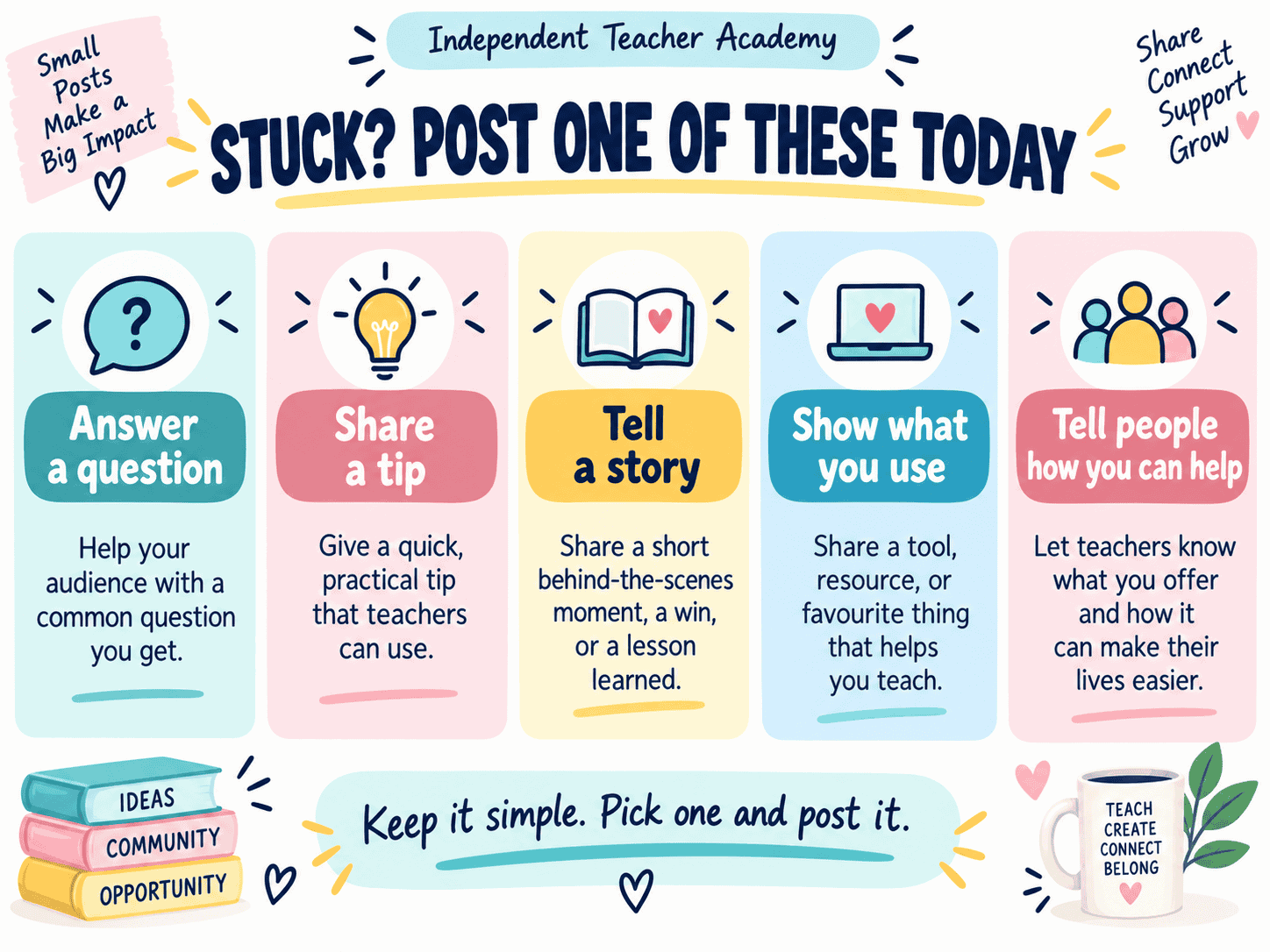
Pick one of these:
- Answer one question a student always asks you.
- Share one thing you wish new teachers knew.
- Teach one tiny concept.
- Show one thing you use every day.
- Tell people exactly who you help.
That’s your next post.
Don’t spend three hours making it perfect.
Publish it.
Then choose another idea tomorrow.
Because the secret to never running out of things to post isn’t becoming endlessly creative.
It’s paying attention to the questions, problems, conversations, mistakes, lessons, and stories that are already happening around you every single day.
Leave a Reply