Introduction
If you’ve been thinking about starting a YouTube channel for your independent teaching business—or you’ve been slowly working toward monetization—you may want to move that goal a little higher on your priority list.
YouTube has announced some significant changes to the YouTube Partner Program (YPP) beginning February 1, 2027.
And one of the biggest changes is this:
It is going to become considerably harder for new channels to qualify for ad revenue.
Right now, creators can qualify for full YouTube Partner Program ad and Premium revenue sharing with 1,000 subscribers and either:
- 4,000 qualified public watch hours during the previous 12 months, or
- 10 million qualified Shorts views during the previous 90 days.
Beginning February 1, 2027, those requirements will increase to:
- 8,000 qualified watch hours, or
- 20 million qualified Shorts views,
while the 1,000-subscriber requirement remains. YouTube says creators who are already in YPP will not lose their existing YPP status simply because they don’t meet the new entry threshold.
If you’re an independent teacher who has been sitting at 2,000, 3,000 or even 3,500 watch hours thinking, I’ll get serious about this eventually, your timeline just changed.
But I also want to make something clear:
This does not mean independent teachers should abandon YouTube.
Actually, I think the opposite is true.
YouTube can be an incredibly powerful tool for building an independent teaching business—even if YouTube itself never pays you a dollar.
Let’s talk about exactly what is changing, what it means for teachers, and what I recommend doing between now and February.
What Is Changing With YouTube Monetization in 2027?
YouTube announced its first major changes to YPP entry requirements since 2018.
There are several changes coming, including changes to Premium Lite revenue, Shorts monetization and requirements for keeping a channel active.
But the change that will probably matter most to smaller independent teacher channels is the increase in the threshold required for new creators to receive ad and YouTube Premium revenue sharing.
Here’s how the numbers compare.
| Monetization Route | Current Requirements | Beginning Feb. 1, 2027 |
|---|---|---|
| Subscribers | 1,000 | 1,000 |
| Long-form route | 4,000 watch hours | 8,000 watch hours |
| Shorts route | 10 million views/90 days | 20 million views/90 days |
In other words, the watch-hour requirement is doubling.
For a large entertainment channel, that may simply mean creating more content.
For a teacher creating videos in a relatively small niche, however, adding another 4,000 watch hours can represent a significant amount of additional content and traffic.
The Current YouTube Monetization Requirements
As of September 2026, you can qualify for YouTube’s full ad-revenue tier when you have:
1,000 subscribers
AND either:
4,000 qualified watch hours during the previous 365 days
OR
10 million qualified Shorts views during the previous 90 days.
Remember that Shorts Feed watch time does not count toward those 4,000 long-form watch hours.
There is also a lower YPP entry level for certain features such as fan funding and Shopping.
That currently requires 500 subscribers plus either 3,000 qualified watch hours or 3 million qualified Shorts views, along with applicable requirements. YouTube says those lower thresholds are not changing in February.
The New February 2027 Requirements
Starting February 1, a new applicant seeking ad and Premium revenue sharing will need:
1,000 subscribers
PLUS either:
8,000 qualified watch hours during the previous 365 days
OR
20 million qualified Shorts views during the previous 90 days.
That gives anyone currently working toward the 4,000-hour threshold a pretty important window between now and January 31.
If monetization is something you want, I would not wait until January to start thinking about it.
What If You’re Already Monetized?
Here’s the good news.
If you’re already in the full YouTube Partner Program, you do not suddenly have to earn 8,000 watch hours to stay monetized.
YouTube specifically says the new 8,000-hour/20-million-Shorts requirements apply to new applicants. Existing YPP creators won’t lose long-form ad monetization simply because they don’t meet the new entry requirements.
However, existing YPP creators should still log into YouTube Studio.
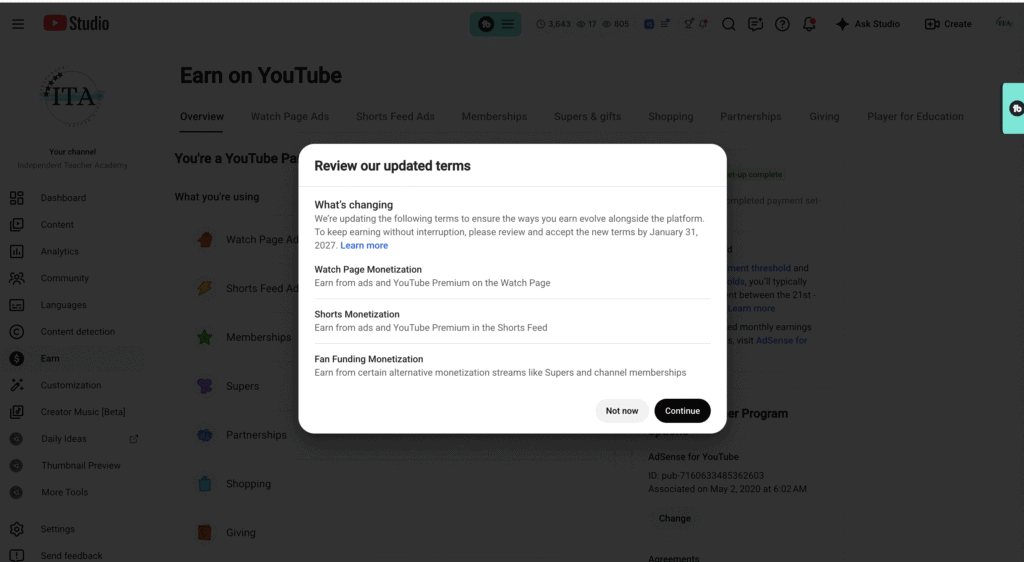
YouTube is introducing updated monetization terms that take effect February 1, 2027. Creators need to review and accept the appropriate updated modules by January 31, 2027 to avoid an interruption in earnings from those features.
If you are already monetized, it will look like this (on desktop):

So even if you’ve been monetized for years, this isn’t something I would completely ignore.
What If You’re Close to Monetization?
This is the group I would pay the most attention to.
Let’s say you currently have:
- 1,000+ subscribers
- 2,700 watch hours
- a library of existing videos
- and five months before the requirements change.
I would absolutely make qualifying under the existing requirements a priority.
You currently need to reach 4,000 watch hours.
If you wait until after February, the target becomes 8,000.
That doesn’t mean you should start throwing random videos onto YouTube trying to collect watch time.
For an independent teacher, every video should ideally accomplish two things at once:
Goal #1: Build your YouTube channel.
Goal #2: Build your teaching business.
That second goal is much more important.
Here are the ways you can be monetized BEFORE February 2027:
Should Independent Teachers Focus on Shorts?
Probably not as your primary monetization strategy.
Shorts can absolutely help teachers get discovered, grow subscribers and repurpose content.
But look at the numbers.
Beginning in February, the Shorts route to full YPP entry will require 20 million qualified Shorts views in 90 days.
That’s enormous for most independent teaching channels.
There is another important Shorts change coming.
Beginning February 1, creators will need to maintain 10 million qualified Shorts views over the previous 90 days to receive Shorts Creator Pool ad and subscription revenue for that period. Falling below that doesn’t remove you from YPP or stop long-form monetization.
For most independent teachers, I’d treat Shorts as a discovery tool rather than the business model.
Use Shorts to get people interested.
Then send them toward:
- a longer YouTube video
- your email list
- your website
- your classes
- your membership
- your digital products
- or another offer inside your teaching business.
Why YouTube Is Still Worth Building Without Ad Revenue
This is where I think independent teachers sometimes get way too focused on the wrong number.
YouTube monetization is nice.
But YouTube does not need to pay you for YouTube to make you money.
Imagine you create a video called:
How to Improve Your English Speaking Confidence
Five hundred people watch it.
YouTube might pay very little for 500 views.
But what if five of those viewers join your email list?
And one eventually becomes a $200/month private student?
Suddenly those 500 views are worth much more than the AdSense revenue attached to them.
The same thing applies if your audience is other teachers.
A video about finding private students might lead someone into one of your courses, memberships or resources.
That’s why I would encourage independent teachers to think of YouTube as a searchable content library for your business, not simply a social media platform.
Unlike a Facebook or Instagram post that may disappear from someone’s feed within hours, a good YouTube video can continue appearing in search results months—or even years—after you publish it.
If you’re still deciding where to put your content efforts, I’ve also compared whether an online teacher should start a YouTube channel or a blog.
What Independent Teachers Should Do Before February
If you want to build your channel before these changes take effect, here’s what I would focus on.
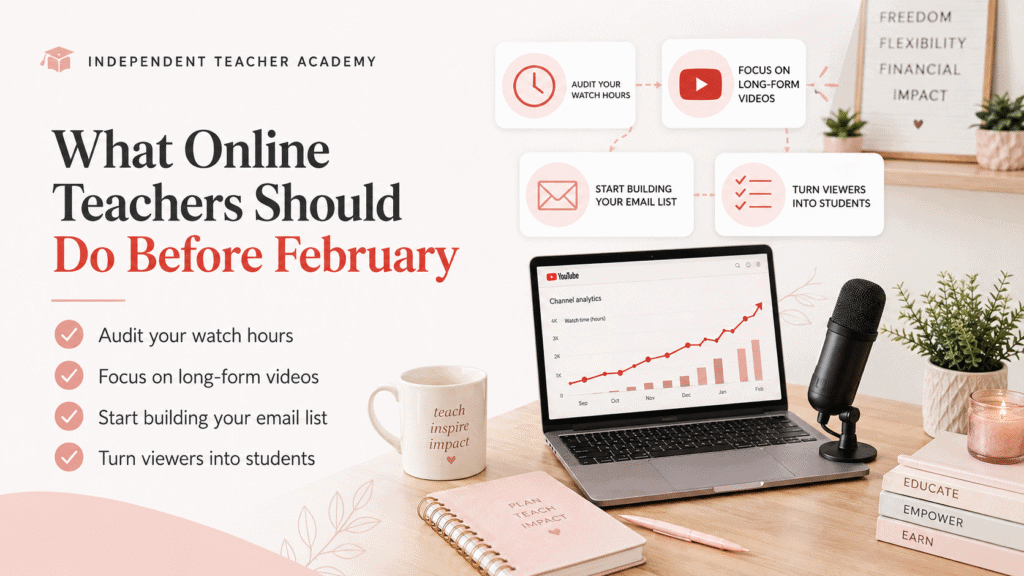
1. Check Your Current Watch Hours Today
Open YouTube Studio and go to the Earn tab.
Find out exactly where you stand.
Don’t just look at total channel watch time. The YPP threshold is based on qualified public watch hours during the applicable 365-day period.
Then do the math.
If you’re at:
3,500 hours: You have a very realistic shot at getting there.
2,500 hours: You may still have a realistic shot.
500 hours: I wouldn’t create junk content trying to race toward 4,000. I’d concentrate on building a strong channel and business instead.
Your strategy should depend on your starting point.
2. Prioritize Long-Form Searchable Videos
For most independent teachers, this is where I would spend the majority of my effort.
Create videos answering things people are actively searching for.
If you teach English, that might include:
- Common English mistakes
- English pronunciation lessons
- Business English
- IELTS preparation
- English job interview practice
- Vocabulary lessons
- English conversation practice
If your audience is teachers, topics might include:
- How to find private online students
- How much to charge for online classes
- How to create an online teaching website
- How to get students without a teaching platform
- Online teaching equipment
- How to choose your teaching niche
- How to create lesson packages
You do not need millions of people to care about your topic.
You need the right people to care about it.
3. Make Videos That Encourage Longer Watch Time
Remember: your goal isn’t simply views.
You need watch hours.
A two-minute video receiving 1,000 views produces significantly less potential watch time than a helpful 15-minute tutorial people actually stay to watch.
That doesn’t mean artificially stretching videos.
It means creating content deep enough to genuinely answer someone’s question.
Tutorials, case studies, walkthroughs and step-by-step videos can be particularly useful for this.
4. Update Your Existing Videos
You may already have content capable of generating considerably more traffic.
Look through YouTube Studio for videos that are:
- getting impressions but have a low click-through rate
- getting search traffic
- ranking for useful keywords
- holding viewers longer than your other videos
- related to topics people consistently ask about
Those videos are telling you what your audience wants.
Consider updating thumbnails and titles where appropriate, and then create additional videos around those successful topics.
You don’t always need a completely new strategy.
Sometimes YouTube has already shown you what is working.
5. Create Content Clusters
Instead of creating ten unrelated videos, create several videos around one problem.
For example:
Finding Private Students
You might create:
- 7 Ways to Find Private Online Students
- How I Would Find My First 5 Online Students
- How to Get Students Without Outschool or Preply
- How to Use Facebook to Find Online Students
- Why You’re Not Getting Private Students
- How Much Should You Charge Private Students?
Those videos can link to one another.
Someone who finds one may watch three.
That’s good for your audience, good for watch time and good for establishing your expertise.
6. Start an Email List If You Haven’t Already
If you’re putting all this work into YouTube, do not let YouTube own your entire audience.
Give viewers a reason to join your email list.
That might be:
- a free lesson
- a vocabulary guide
- a teacher business checklist
- a lesson-planning resource
- a pricing calculator
- a free mini training
Your YouTube subscriber belongs to YouTube’s platform.
Your email subscriber gives you a much more direct connection.
7. Give Every Video a Business Purpose
Before you record, ask:
What do I want this viewer to do next?
Not every video needs to pitch something.
But there should be a logical next step.
Maybe it’s:
Watch another video.
Or:
Download my free guide.
Or:
Join my email list.
Or:
Book a class.
Or:
Learn about my program.
That turns your channel from a collection of videos into a marketing system.
8. If You’re Close to 4,000 Hours, Create a Publishing Sprint
If you’re genuinely close to the current monetization threshold, I’d use the next several months strategically.
You don’t necessarily need to publish every day.
Instead, commit to something sustainable such as:
One strong long-form video every week.
That would give you roughly 20 new long-form videos before February.
More importantly, you’ll also have several months for those earlier videos to accumulate views and watch time.
Do not wait until January 25 and attempt to produce 20 videos at once.
YouTube content needs time to circulate.
A Simple YouTube Strategy for Independent Teachers
If I were starting an independent teaching YouTube channel right now, my strategy would be extremely simple.
I’d choose one specific audience.
Then identify 3–5 problems that audience repeatedly searches for.
I’d create one useful long-form video every week answering those questions.
I’d turn pieces of those videos into Shorts.
I’d send viewers to an email list.
And I’d create an offer solving a larger version of the same problem.
The system looks like this:
YouTube Search → Helpful Video → Email List → Relationship → Paid Offer
That’s a teaching business.
YouTube ad revenue?
That’s an additional income stream on top of it.
And I think that distinction is going to become even more important as the requirements for ad monetization increase.
You also don’t have to create every piece of content from scratch. One of my favorite strategies is turning YouTube videos into blog posts, which lets the same topic work for you in both YouTube and Google search
Frequently Asked Questions
When do the new YouTube monetization requirements start?
The new YPP ad and Premium entry thresholds begin February 1, 2027.
How many watch hours will I need in 2027?
New applicants will need 8,000 qualified watch hours during the previous 365 days, along with 1,000 subscribers, to qualify through the long-form route for ad and Premium revenue sharing.
How many watch hours do I need right now?
Currently, the requirement is 4,000 qualified watch hours during the previous 365 days plus 1,000 subscribers.
Are YouTube Shorts requirements changing?
Yes. Beginning February 1, the YPP entry route through Shorts increases from 10 million to 20 million qualified Shorts views during the previous 90 days for new applicants.
Creators will also need 10 million qualified Shorts views during a rolling 90-day period to receive Shorts Creator Pool ad and subscription revenue for that period.
Will I lose monetization if I’m already in YPP?
YouTube says creators already in YPP will not lose their long-form monetization simply because they don’t meet the new 8,000-hour or 20-million-view entry thresholds. Those thresholds apply to new applicants.
Existing monetized creators should still review and accept YouTube’s updated monetization terms by January 31, 2027 to prevent interruptions to applicable earnings.
Is starting a YouTube channel still worth it for online teachers?
Absolutely—but I wouldn’t build your entire strategy around AdSense.
For an independent teacher, a relatively small YouTube channel can still generate students, email subscribers, product sales and business opportunities.
Those may ultimately be worth significantly more than the advertising revenue generated by the channel itself.
Final Thoughts
I don’t think the takeaway from these changes should be:
“It’s too late to start YouTube.”
I think the takeaway should be:
“I need to stop waiting.”
If you’re already approaching 4,000 watch hours, you now have a very compelling reason to make YouTube a priority before February 1.
And if you’re nowhere near monetization?
Start anyway.
Because an independent teacher doesn’t need 100,000 subscribers.
You don’t even need 10,000.
You need the right people finding you when they’re searching for the exact thing you teach or sell.
Build videos that answer their questions.
Build an email list that lets you stay connected to them.
Build offers that solve their bigger problems.
Then when YouTube eventually starts paying you too?
That’s another income stream—not the entire business.
At Independent Teacher Academy, that’s the goal: building a teaching business that you control rather than depending entirely on one platform for your students or your income.
YouTube has actually offered more than one level of monetization for creators, which I broke down in my guide to getting monetized on YouTube without 1,000 subscribers.
Leave a Reply