

Marketing your online teaching business can easily turn into a full-time job of its own.
You sit down to post something on social media, then realize you should probably send an email. Then you remember you have not updated your website. Then you start wondering whether you should be making YouTube videos, posting Reels, joining Facebook groups, creating Pinterest pins, or messaging former students.
Two hours later, you have opened twelve tabs and still have not actually marketed your business.
The solution is not to do more. It is to give each part of your marketing a job and a place in your week.
This weekly marketing routine for online teachers is designed to help you stay visible, attract new students, and follow up with potential clients without feeling like you need to be online all day.
The Goal of a Weekly Marketing Routine
Your marketing routine should do four things consistently:
- Help new people discover you.
- Give potential students or parents a reason to trust you.
- Stay in contact with people who already know about your teaching business.
- Make it easy for interested people to take the next step and book with you.
You do not need to be on every platform. You need a repeatable system that keeps your business moving forward.
If you regularly struggle with what to publish, start with our 50 teacher content ideas for when you do not know what to post.
The 5-Day Marketing Routine for Online Teachers
You can move these days around to fit your teaching schedule. The important part is that each day has a specific purpose.
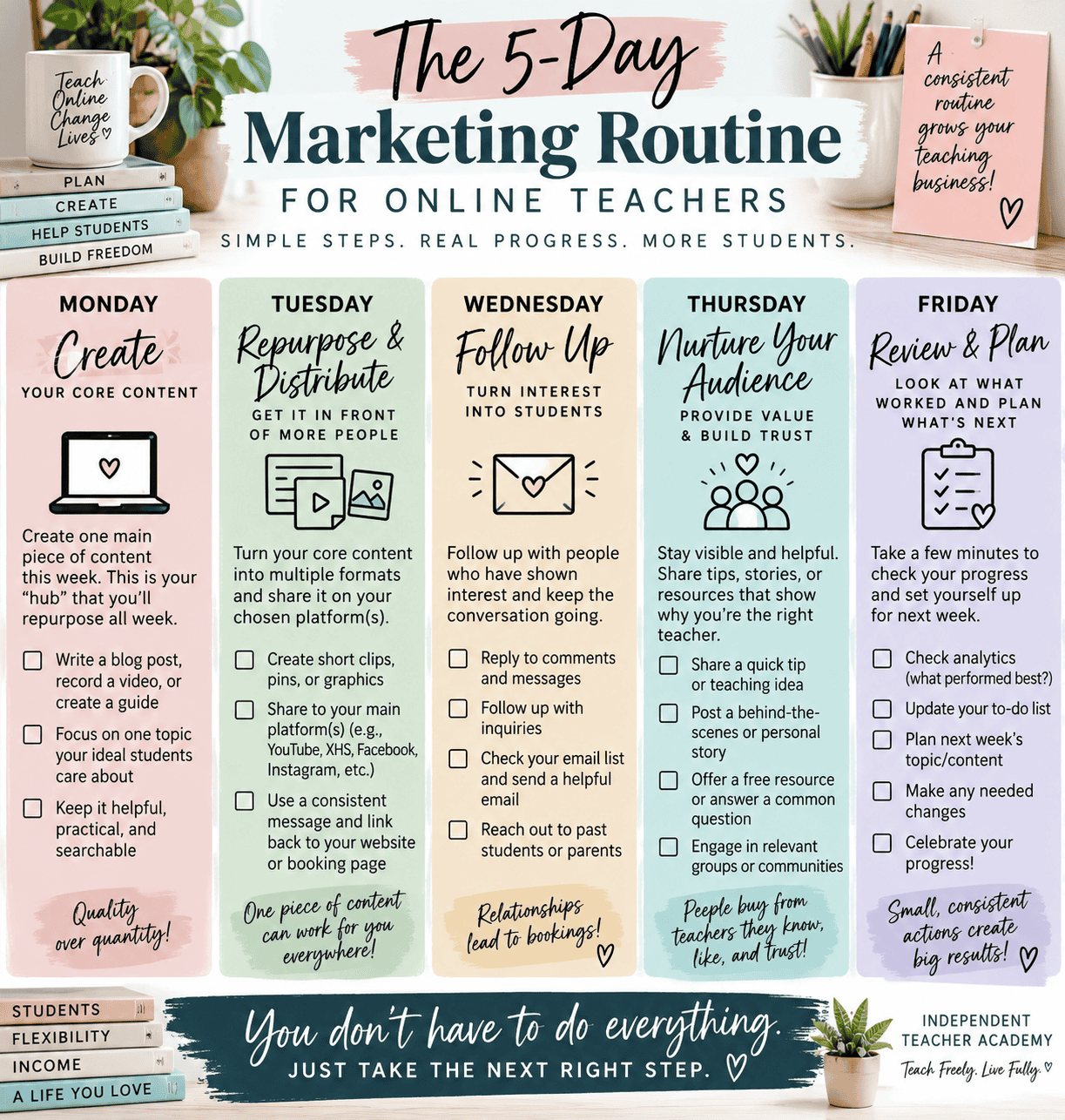
Monday: Plan and Create Your Main Piece of Content
Monday is your content creation day.
Choose one useful topic your ideal student or parent is already searching for and create one substantial piece of content around it.
That might be:
- A blog post.
- A YouTube video.
- A longer Facebook post.
- An educational carousel.
- A helpful email.
The easiest way to avoid content burnout is to stop treating every platform like it needs completely different content. Create one strong idea and then reuse it throughout the week.
For example, if you teach conversational English, your main topic could be five mistakes intermediate English learners make when speaking at work.
That one topic could later become a YouTube video, three short-form videos, an email, several social posts, and a Pinterest pin.
Your Monday task is simply to create the main piece.
Tuesday: Repurpose and Get Discovered

Tuesday is your visibility day.
Take Monday’s content and turn it into smaller pieces that can reach people in different places.
For example:
- Pull one tip from the article and make a short Reel.
- Turn the main points into a carousel.
- Create a Pinterest graphic that links back to the blog post.
- Post a quick tip in a relevant Facebook group where promotion is allowed.
- Turn one section into a short YouTube video or Short.
You are not creating five new ideas. You are distributing one idea five different ways.
This is especially useful for teachers who feel like they spend too much time creating content that disappears after one post.
Wednesday: Follow Up With Real People
Wednesday is your relationship day, and this is the day many teachers skip.
Marketing is not only about reaching strangers. Some of the easiest bookings come from people who already know you.
Spend 20 to 30 minutes following up with people such as:
- Parents who previously asked about lessons.
- Former students.
- People who attended a trial lesson but did not book.
- Current students who may be ready for an additional class.
- People who replied to an email or asked a question on social media.
The goal is not to pressure anyone. It is to reopen conversations.
A simple message can be enough: check in, ask how they are doing, mention a relevant class or opening, and give them an easy way to respond.
If your business is still very new, our guide on getting your first five online students has additional ideas for finding those first clients.
Thursday: Email Your Audience
Thursday is your email marketing day.
You do not need a huge email list for email marketing to matter. A small list of people who are genuinely interested in what you teach can be more useful than thousands of random social media followers.
Your weekly email does not need to be complicated. Use this simple format:
- Share one useful teaching tip or insight.
- Link to your newest piece of content.
- Mention your current offer, class, tutoring availability, or next step.
That is enough.
The purpose of the email is to remind people that you exist and continue building trust over time.
If email is something you have been avoiding, read Email Marketing for Teachers: Why It Is a Game-Changer and How to Start.
Friday: Review What Worked and Prepare for Next Week
Friday is your review day.
You do not need an elaborate spreadsheet with fifty metrics. Look at the numbers that actually help you make decisions.
Ask:
- Which post received the most clicks?
- Which topic generated comments or questions?
- Did anyone join your email list?
- Did anyone inquire about lessons?
- Which video kept people watching?
- Which email received replies?
- Did any piece of content lead directly to a booking?
Then use that information to decide what you should talk about next week.
Do not automatically move on to a completely different subject when something works. If people respond to a topic, create more useful content around it.
A Simple Weekly Marketing Schedule
| Day | Primary Task | Goal |
|---|---|---|
| Monday | Create one main piece of content | Build authority and useful content |
| Tuesday | Repurpose and distribute | Reach new people |
| Wednesday | Follow up with leads and past students | Turn existing interest into conversations |
| Thursday | Send one email | Nurture your audience and promote your offer |
| Friday | Review results and plan next week’s topic | Make your marketing smarter over time |
What If You Only Have 30 Minutes a Day?
You can still use this routine.
Try this simplified version:
- Monday: Write or record for 30 minutes.
- Tuesday: Create two short posts from Monday’s content.
- Wednesday: Follow up with five people.
- Thursday: Send one short email.
- Friday: Spend 15 minutes checking results and 15 minutes planning next week.
Consistency matters more than having a perfect marketing system.
Choose One Primary Discovery Platform

One of the fastest ways to burn yourself out is trying to grow everywhere at once.
Choose one platform where new people can regularly discover you and give that platform most of your attention.
Depending on your audience and teaching niche, that might be:
- YouTube.
- Google through blogging and SEO.
- Facebook.
- Instagram or short-form video.
- Pinterest.
You can still maintain other platforms, but one should be your primary growth engine.
But before you choose a platform, choose the market you want to reach. A teacher who primarily wants to work with Chinese students and parents may need a very different marketing system from a teacher targeting students in the United States, Europe, or other international markets.
If you are focused on Chinese families, Xiaohongshu (XHS) can help new students and parents discover you, while WeChat can be useful for continuing conversations and building relationships. Teachers using WeChat may also want our guide to getting paid by Chinese ESL students using WeChat Pay and Stripe.
If XHS and WeChat are where your market is, you do not also need to convince yourself that you must simultaneously grow Facebook, Instagram, YouTube, Pinterest, and every other platform. The reverse is true too: if you primarily serve Western or broader international students, Google, YouTube, Facebook, Instagram, or another platform may make more sense, and you do not need to add Chinese social platforms just because another teacher uses them.
Pick your market first. Choose the platforms where those students and parents actually spend their time. Build a manageable system there, and expand later if it makes sense for your business.
The best platform is not necessarily the trendiest one. It is the one where your ideal students can actually find you and where you are willing to publish consistently.
Create Content That Leads Somewhere
Every piece of marketing content should have a job.
Sometimes the goal is simply to help someone discover you. Other times you want the person to:
- Read another article.
- Watch another video.
- Join your email list.
- Ask about a class.
- Book a trial lesson.
- Purchase a resource.
You do not need to aggressively sell in every post. But you should know what you want someone to do after consuming your content.
Teachers often make the mistake of creating helpful content with no obvious next step. If you are getting views but very few inquiries, this is one of the first things to check.
For more on the mistakes that can slow down student acquisition, read The 7 Biggest Mistakes Online Teachers Make When Trying to Get Students.
Batching Makes This Routine Much Easier
If you have a busy teaching schedule, you do not have to complete every task on the exact day listed.
You could batch several tasks at once.
For example, you might record four videos in one afternoon, schedule a month’s worth of Pinterest graphics, or draft several emails in advance.
The weekly routine is less about rigidly following a calendar and more about making sure none of the important pieces of your marketing disappear for months at a time.
Your Weekly Marketing Checklist
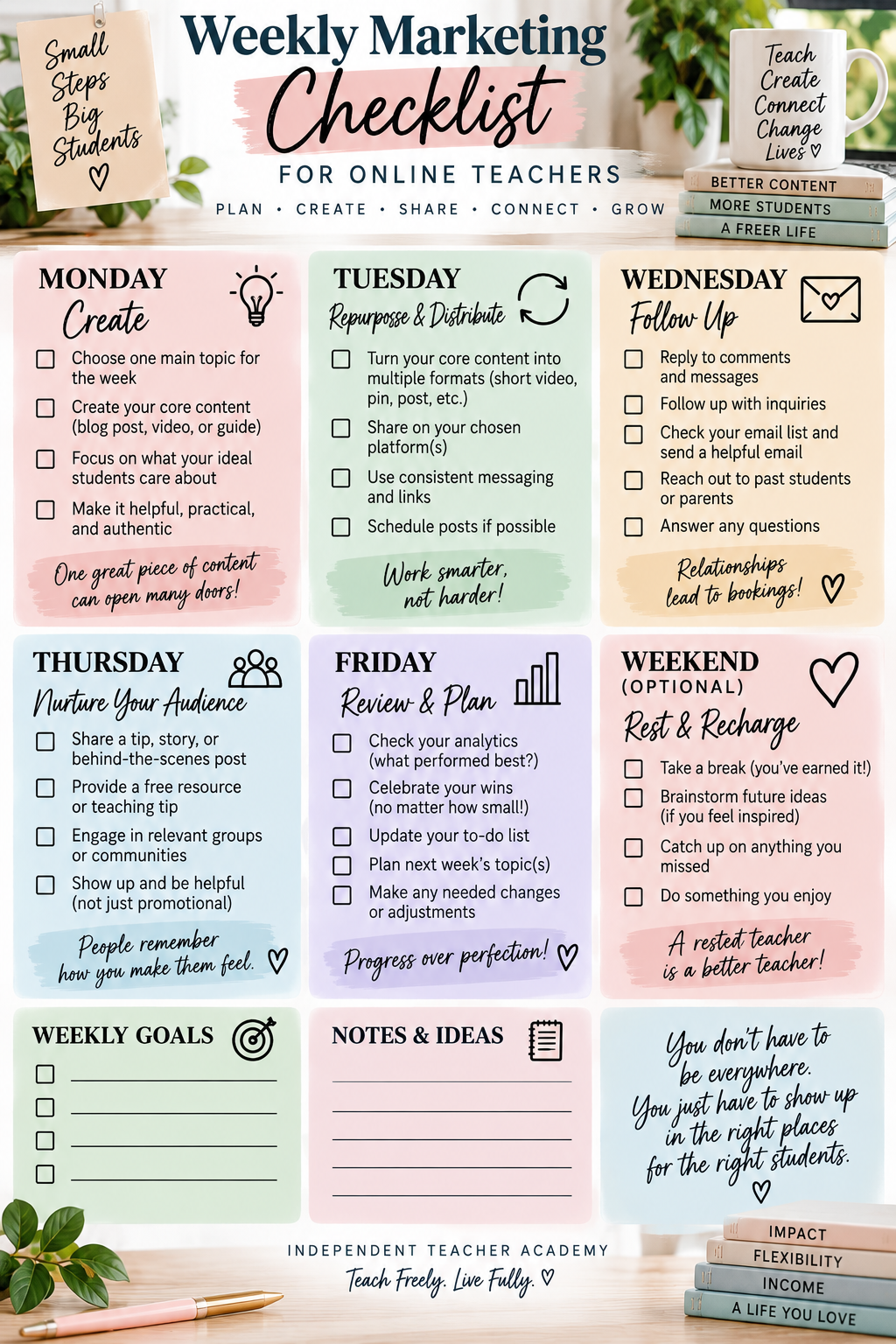
Before you finish each week, check that you have:
- Published one useful long-form piece of content.
- Repurposed that content into smaller pieces.
- Done something that helps new people discover you.
- Followed up with potential or former students.
- Contacted your email audience.
- Included a clear next step somewhere in your content.
- Reviewed what generated clicks, conversations, leads, or bookings.
- Chosen next week’s main topic.
You Do Not Need to Market Your Teaching Business All Day
A successful marketing routine should make your business feel more manageable, not less.
You do not need to post ten times a day. You do not need to join every new platform. And you do not need to create completely different content for every place you show up.
Create something useful. Repurpose it. Stay in contact with real people. Build your email list. Pay attention to what works. Then repeat.
That simple routine can do far more for your teaching business than constantly jumping from one marketing strategy to another.
If you are rebuilding or growing your business this year, you may also want to read what I would do if I were starting an online teaching business from scratch in 2026.
Leave a Reply