

Introduction
You’ve probably heard people talk about email marketing… but maybe you thought, “That’s for big businesses, not online teachers like me.”
Actually, it’s the opposite.
If you’re teaching independently (or planning to), email marketing is one of the most powerful tools you can use to build trust, fill your classes, and create predictable income—all without constantly posting on social media.
Let’s break down why email marketing is a must-have in your teacher business—and how to get started even if you’re brand new.
*This post may contain affiliate links.
1. Why Email Marketing Works So Well for Teachers
Your students (and their parents) are busy.
They don’t always see your Instagram post or Facebook story. But you know what they do check?
📬 Their email inbox.
Email marketing works so well because it gives you direct, uninterrupted access to the people who are most likely to book your services. You’re not just shouting into the void—you’re landing directly in someone’s inbox, where they’re much more likely to pause and listen.
Even better? Email builds trust over time. Parents get to know your voice, your values, and your teaching style long before they book. That means when they’re finally ready to invest, you’re the obvious choice.
Plus, unlike social media, email isn’t affected by algorithms. You decide when and how your message is seen. Whether you’re launching a class, filling up summer sessions, or offering a new service, your email list becomes a reliable, consistent way to get results.
In short: your email list is an asset. It grows with your business, and it helps you go from “just another teacher” to the teacher families want to book.
2. What You Can Use Email For in Your Business
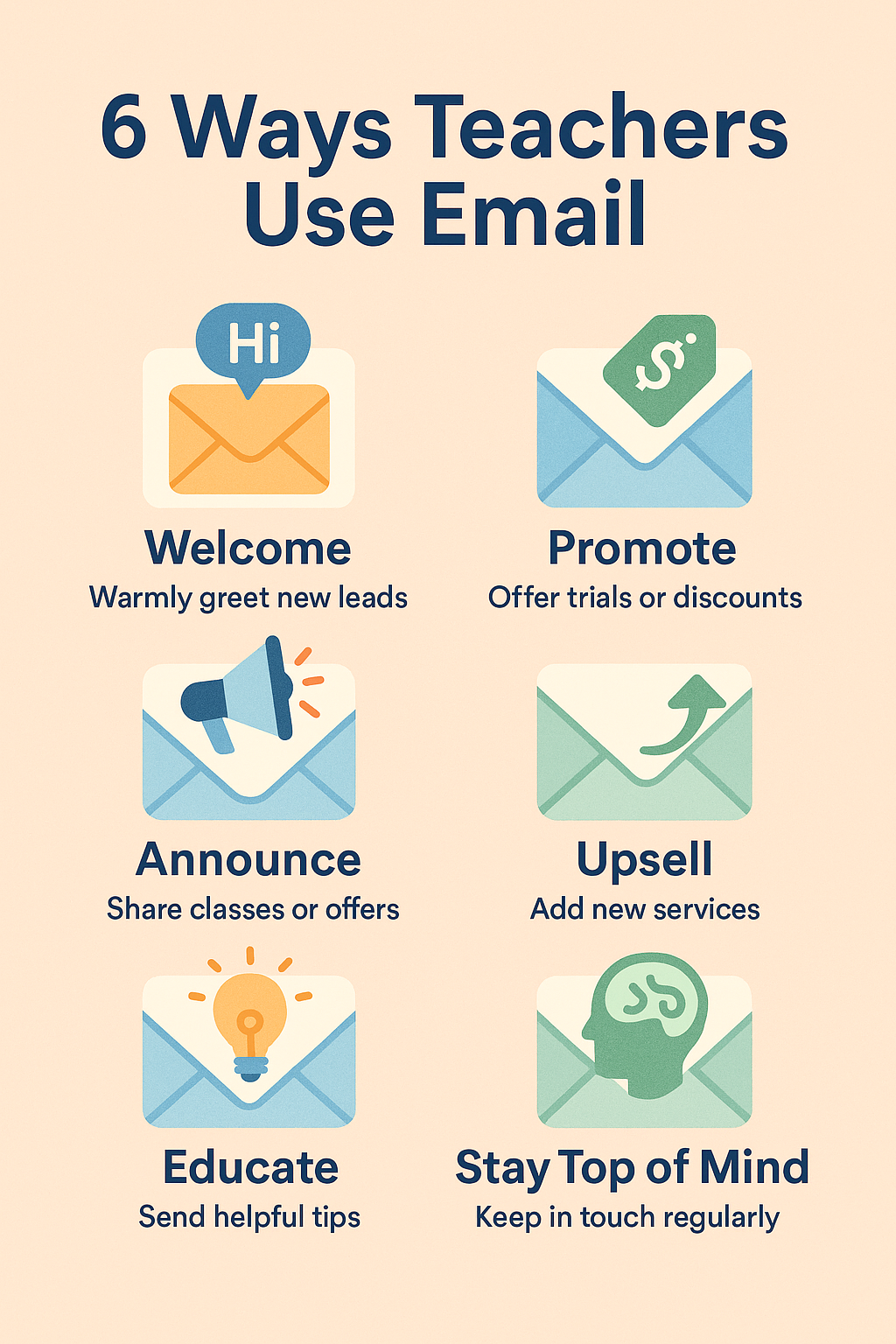
Email isn’t just for reminders or promotions—it’s a direct line to your audience’s brain (and heart). Here’s how online teachers are using email to grow their businesses every day:
- Welcome New Leads – When someone signs up for your freebie or books a trial, your email can guide them through what to expect next. A simple welcome message can ease anxiety and create excitement.
- Build Trust With Educational Content – Share quick parent tips, learning strategies, or behind-the-scenes looks at how you teach. These emails remind families that you’re an expert—not just someone trying to sell a class.
- Promote Trial Lessons – Email lets you offer timely promotions like “Book your first class this week and get a bonus resource!” It’s a great way to move leads from interested to enrolled.
- Announce New Classes or Time Slots – Got an opening in your schedule? Use your email list to fill it first. Your subscribers are warm leads—they already trust you more than strangers on social media.
- Sell Additional Offers – Do you offer feedback packages, reading bundles, writing clubs, or seasonal camps? Email is the perfect way to introduce these and help parents see the value in upgrading.
- Stay Top of Mind – Not every parent is ready to sign up right away. Email lets you show up regularly so when they are ready, you’re the first person they think of.
Think of your emails like tiny relationship-builders. Each one helps parents feel more confident saying yes—and makes you look more professional and trustworthy.
3. What Makes Email Better Than Social Media
Let’s be honest: social media can be exhausting. The constant pressure to post, keep up with trends, and compete for attention is draining—and most of your followers don’t even see your content.
Here’s why email wins:
- You Own Your List – Unlike social media platforms that can shut down your account or throttle your reach, your email list belongs to you. No one can take it away, and you can move it between platforms if needed.
- Deliverability is Predictable – When you send an email, it goes to someone’s inbox. There’s no algorithm deciding whether it should be shown to them.
- You’re Speaking to a Warmer Audience – People don’t give their email to just anyone. If someone’s on your list, they’ve already shown interest in what you offer. That means they’re more likely to engage, reply, and eventually buy.
- It Feels Personal – Emails allow you to write as if you’re speaking directly to one person. That connection builds loyalty and makes your business feel human—not like just another ad on a feed.
- It Converts Better – Study after study shows email marketing has a higher ROI than any other marketing channel—including social media. When you want someone to take action (book, reply, enroll), email is the place to do it.
Bonus? You can repurpose content. That amazing post you made for Facebook? Send it to your list. That tip you emailed? Turn it into a Reel. Email supports everything else you’re doing.
Bottom line: social media is where people scroll. Email is where they act.
4. The 3 Simple Things You Need to Start
You don’t need a fancy funnel. You just need:
✅ An Email Marketing Platform
→ I highly recommend Kit (formerly ConvertKit)—it’s what I personally use and love. Kit is built specifically for creators and teachers. It’s simple to set up, beginner-friendly, and powerful enough to grow with your business. (Full disclosure: this is my affiliate link. I only recommend tools I truly believe in!)
✅ A Lead Magnet
→ This is a freebie that gives value (like a checklist, a worksheet, or a free trial). You offer this in exchange for an email. If you’re stuck on what to create, be sure to join Teacher Boss Society and check out the Lead Magnet Challenge we did in May 2025—it walks you through step by step and helps you create your own lead magnet from scratch!
✅ A Welcome Sequence
→ This is 3–5 emails that introduce who you are, how you help, and what to do next. If writing those emails feels overwhelming, you’re not alone—and we’ve got help for that too. Inside Teacher Boss Society, we hosted an entire Email Sequence Challenge in June 2025. It walked members through crafting a powerful nurture sequence that builds trust and turns subscribers into paying students. It’s available anytime inside the member hub!
Once this is in place, your business can grow on autopilot.
5. What to Write in Your First Emails
Wondering what to send? Start here:
Email 1 – Welcome & Deliver Your Freebie
→ Be friendly. Introduce yourself and give them what you promised.
Email 2 – Your Story
→ Share why you teach, what makes your classes different, and a relatable moment.
Email 3 – Value Tip
→ Teach them something helpful. Make them think, “Wow, she really knows her stuff.”
Email 4 – Offer a Next Step
→ Invite them to book a trial, reply with a question, or check out your services.
Pro tip: Make these conversational. Parents don’t want salesy emails—they want connection.
Check out the full sequence and more ideas in this training (this is actually Day 1 of our June Challenge in Teacher Boss Society– I don’t usually share these, but I wanted to help you out as much as possible!)
6. What’s Next?
If you’re not using email yet, now is the time. It doesn’t need to be overwhelming. Start simple:
- Choose a platform
- Create one small freebie
- Write 3–4 short emails
Want help building your first email list and welcome sequence?
That’s exactly what we do inside Teacher Boss Society. You don’t have to figure it all out alone.
Leave a Reply