
Teaching Business English online can be one of the most rewarding ways to build a career as an independent online teacher. Instead of focusing primarily on everyday vocabulary, Business English lessons help adult learners communicate more effectively in professional situations.
Your students might need to prepare for an important job interview, participate confidently in international meetings, write professional emails, or communicate with English-speaking customers.
You don’t need to be a corporate executive or have a business degree to teach Business English online. You need to understand your students’ goals, identify their communication needs, and design lessons that help them use English confidently at work.
What Is Business English?
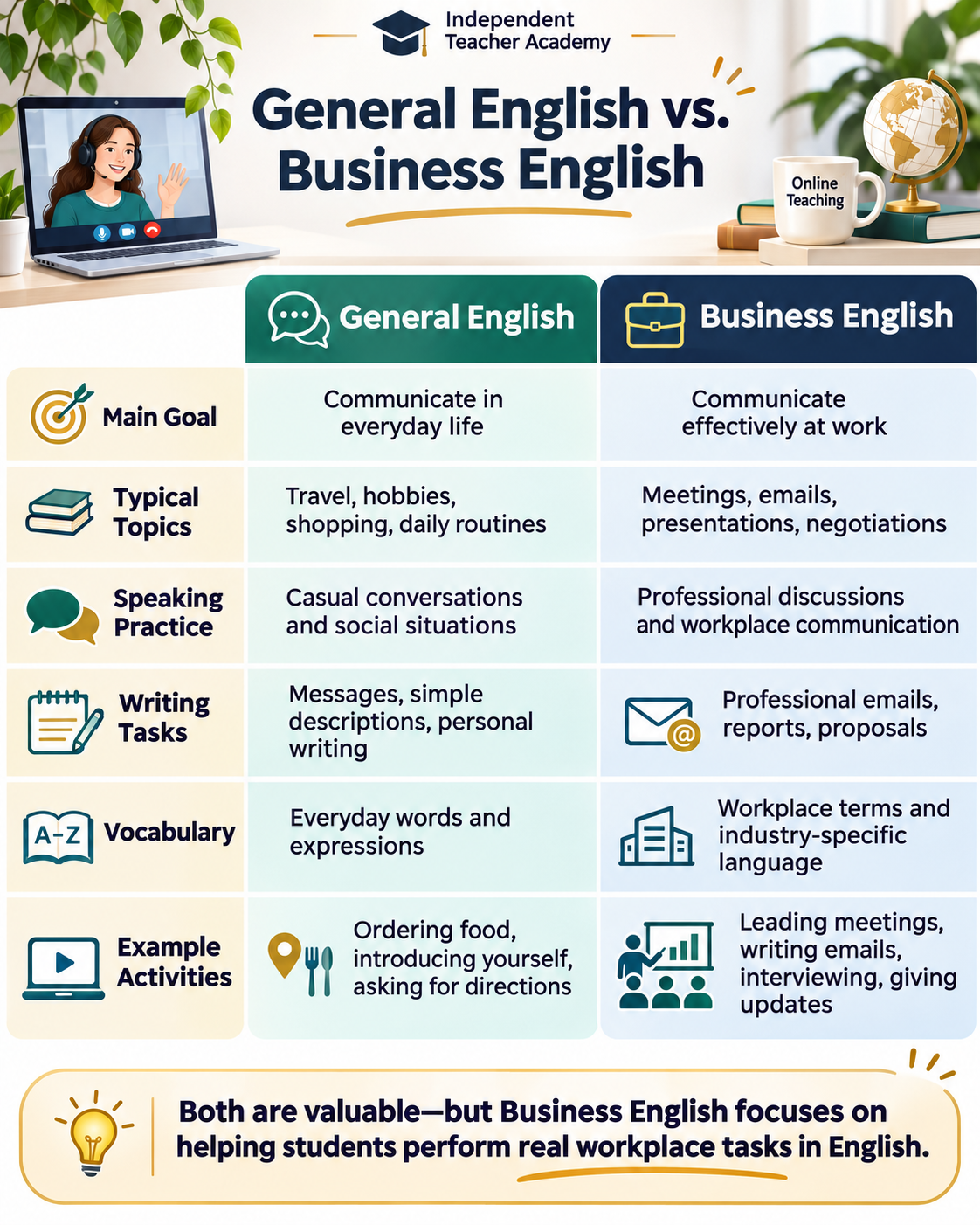
Business English is a specialized area of English language teaching focused on communication in professional environments. Rather than memorizing corporate vocabulary, students learn to complete authentic workplace tasks.
- Professional speaking and listening
- Writing business emails and messages
- Participating in meetings
- Giving presentations
- Negotiating and making proposals
- Job interviews and career development
- Workplace vocabulary and professional etiquette
- Intercultural communication
A student who knows the definition of “negotiate” but cannot discuss pricing with a client still needs practical communication practice.
Who Needs Business English Lessons?
Professionals at International Companies
These learners need to participate in virtual meetings, explain projects, write emails, give updates, and understand colleagues.
Job Seekers
Students preparing for English-speaking positions need help discussing work experience, answering interview questions, and asking appropriate questions of employers.
Managers and Team Leaders
Managers may need to lead meetings, give feedback, handle disagreements, and communicate expectations diplomatically.
Entrepreneurs and Small Business Owners
Business owners use English to talk with suppliers, sell products, manage clients, and expand internationally.
University Students and Recent Graduates
New professionals can practice workplace introductions, networking, presentations, and professional correspondence.
Business English students do not all need the same lessons. An engineer and a marketing professional may have very different workplace goals.
Step 1: Conduct a Business English Needs Analysis
Before planning your first lesson, identify what your student needs to accomplish. A needs analysis goes beyond their general English level and asks about their job, responsibilities, communication challenges, and goals.
Ten Questions to Ask Business English Students
- What is your current job or profession?
- How often do you use English at work?
- Who do you communicate with in English?
- Which professional situations are most difficult?
- Do you primarily need speaking, writing, reading, or listening?
- Are there upcoming interviews, presentations, or meetings?
- What industry-specific vocabulary do you use?
- How confident do you feel speaking English at work?
- What would you like to accomplish in the next three months?
- How will you recognize improvement?
Ask students to rate their confidence from one to five in meetings, professional emails, presentations, small talk, and customer conversations. A learner who rates meetings a two but emails a four probably needs more meeting practice than email worksheets.
Evaluate Their English Level
Have students introduce themselves professionally, explain a workplace challenge, respond to a sample email, or describe a typical workday. Consider vocabulary, grammar, fluency, pronunciation, listening comprehension, and communication strategies. CEFR levels can guide lesson difficulty.
Step 2: Choose Business English Lesson Topics
Business English Lesson Topic 1: Professional Introductions and Networking
Lesson objectives: Introduce themselves professionally, describe responsibilities, ask networking questions, and maintain brief conversations.
Useful language:
- “I’m responsible for managing…”
- “I specialize in…”
- “Could you tell me more about your role?”
Activity idea: Networking role-play: simulate an international conference. Give the learner a professional profile and three minutes to introduce themselves and ask questions.
Business English Lesson Topic 2: Writing Professional Emails
Lesson objectives: Use professional greetings, polite requests, clear organization, and audience-appropriate tone.
Useful language:
- “I’m writing to follow up on…”
- “Could you please confirm…”
- “I look forward to hearing from you.”
Activity idea: Rewrite the email: replace “Hey, I need that report ASAP. Send it today” with a clear, polite request and discuss when different tones are appropriate.
Business English Lesson Topic 3: Participating in Meetings
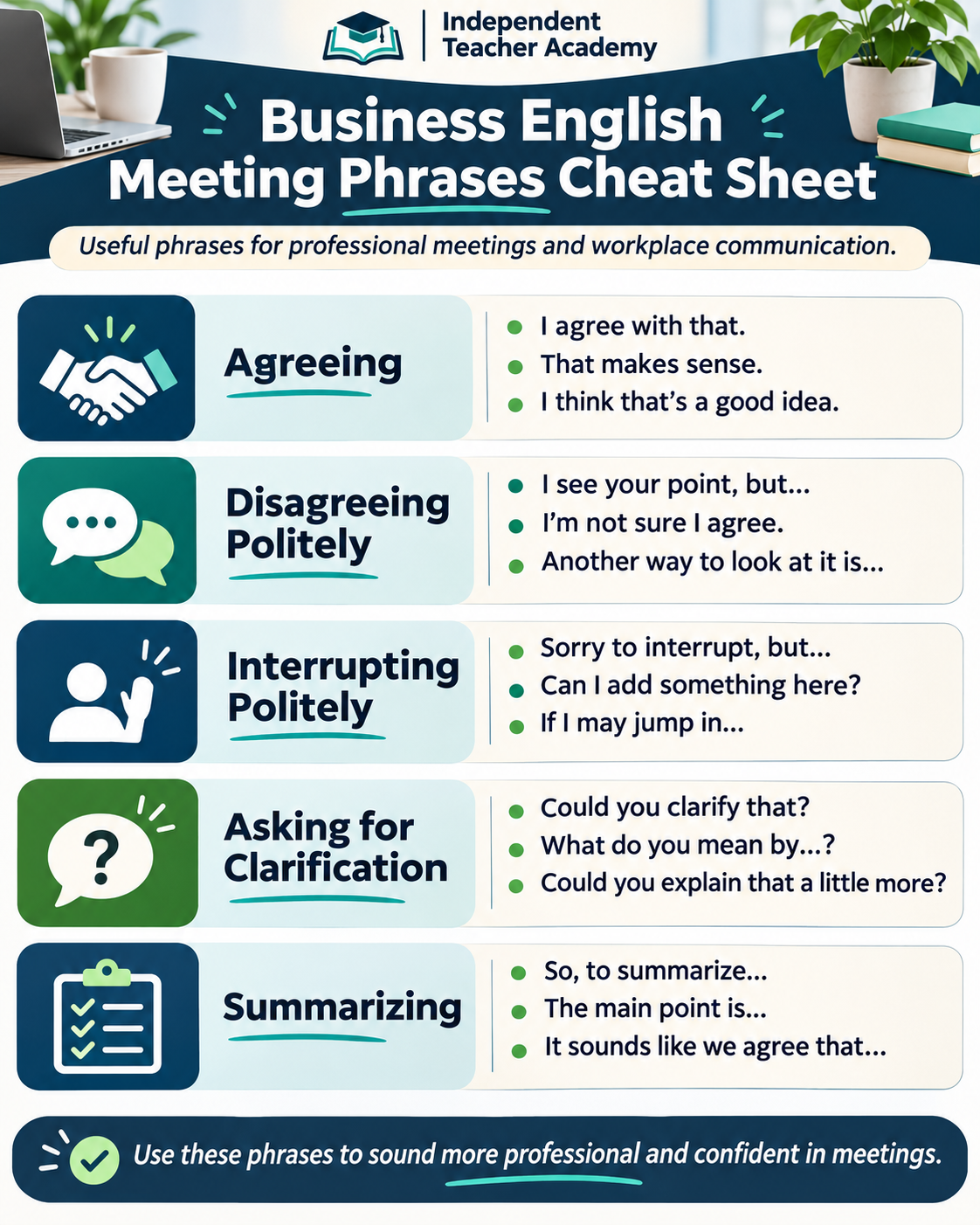
Lesson objectives: Express opinions, agree and disagree politely, request clarification, and summarize decisions.
Useful language:
- “I’d like to add something here.”
- “I see your point, but…”
- “Could you clarify what you mean?”
Activity idea: Meeting simulation: discuss whether a fictional company should introduce a four-day workweek; assign different stakeholder priorities.
Business English Lesson Topic 4: Job Interview Preparation
Lesson objectives: Describe professional experience, strengths, accomplishments, and motivations.
Useful language:
- “Tell me about yourself.”
- “Describe a time you solved a problem at work.”
- “Why are you interested in this position?”
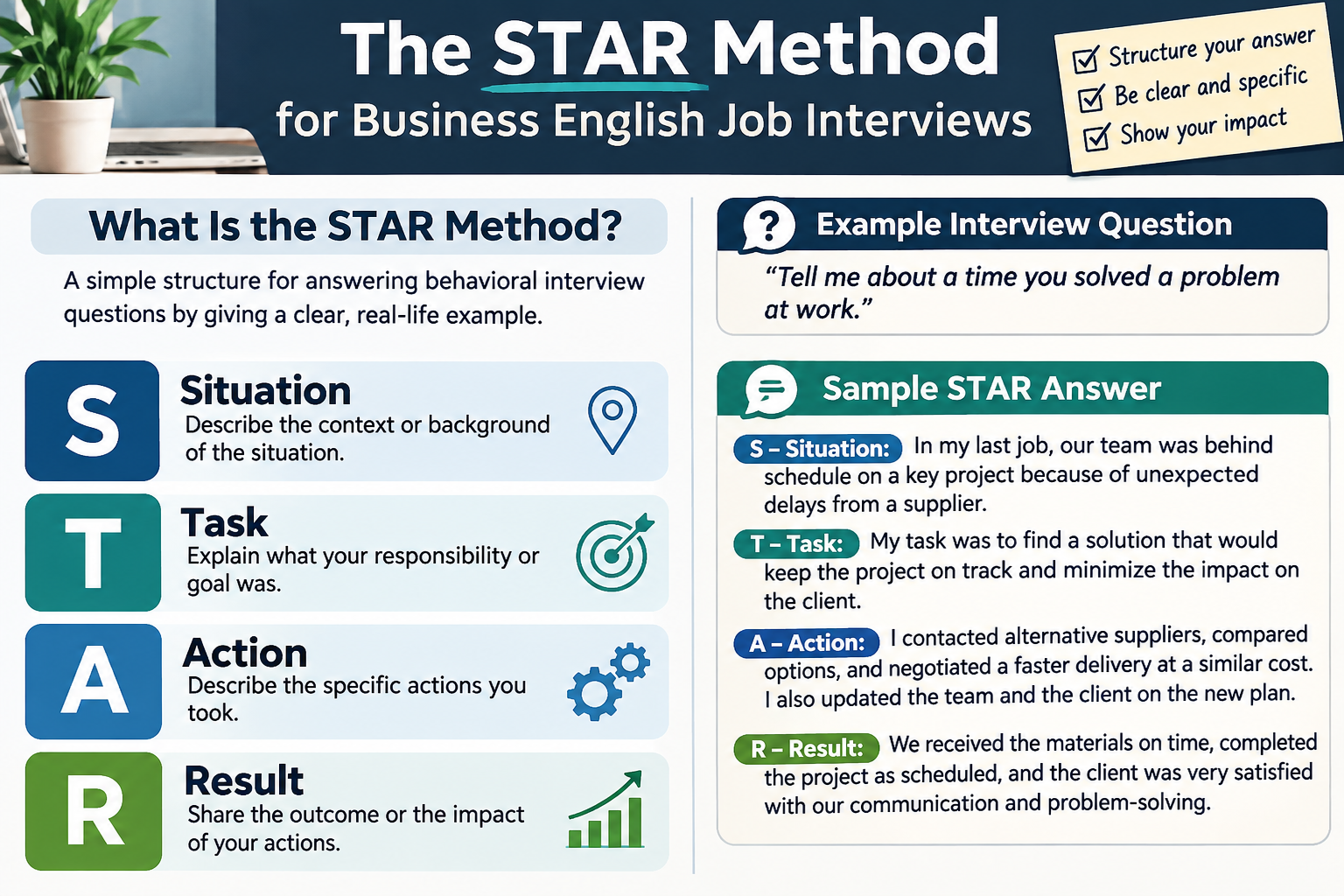
Activity idea: Mock interview: simulate a real job interview, using the STAR structure (Situation, Task, Action, Result) for behavioral questions.
Business English Lesson Topic 5: Giving Presentations
Lesson objectives: Structure a presentation, introduce points, explain data, use transitions, and answer questions.
Useful language:
- “Today, I’d like to discuss…”
- “As you can see from this chart…”
- “The main takeaway is…”
Activity idea: Three-minute presentation: have students explain a product or work project, then respond to follow-up questions.
Business English Lesson Topic 6: Negotiations and Problem-Solving
Lesson objectives: Make suggestions, explain priorities, propose alternatives, and reach agreement.
Useful language:
- “Would you be open to…?”
- “One possible solution would be…”
- “That sounds like a reasonable compromise.”
Activity idea: Supplier negotiation: one person buys supplies, the other sells; negotiate price, delivery, and payment terms.
Step 3: Use Engaging Business English Activities
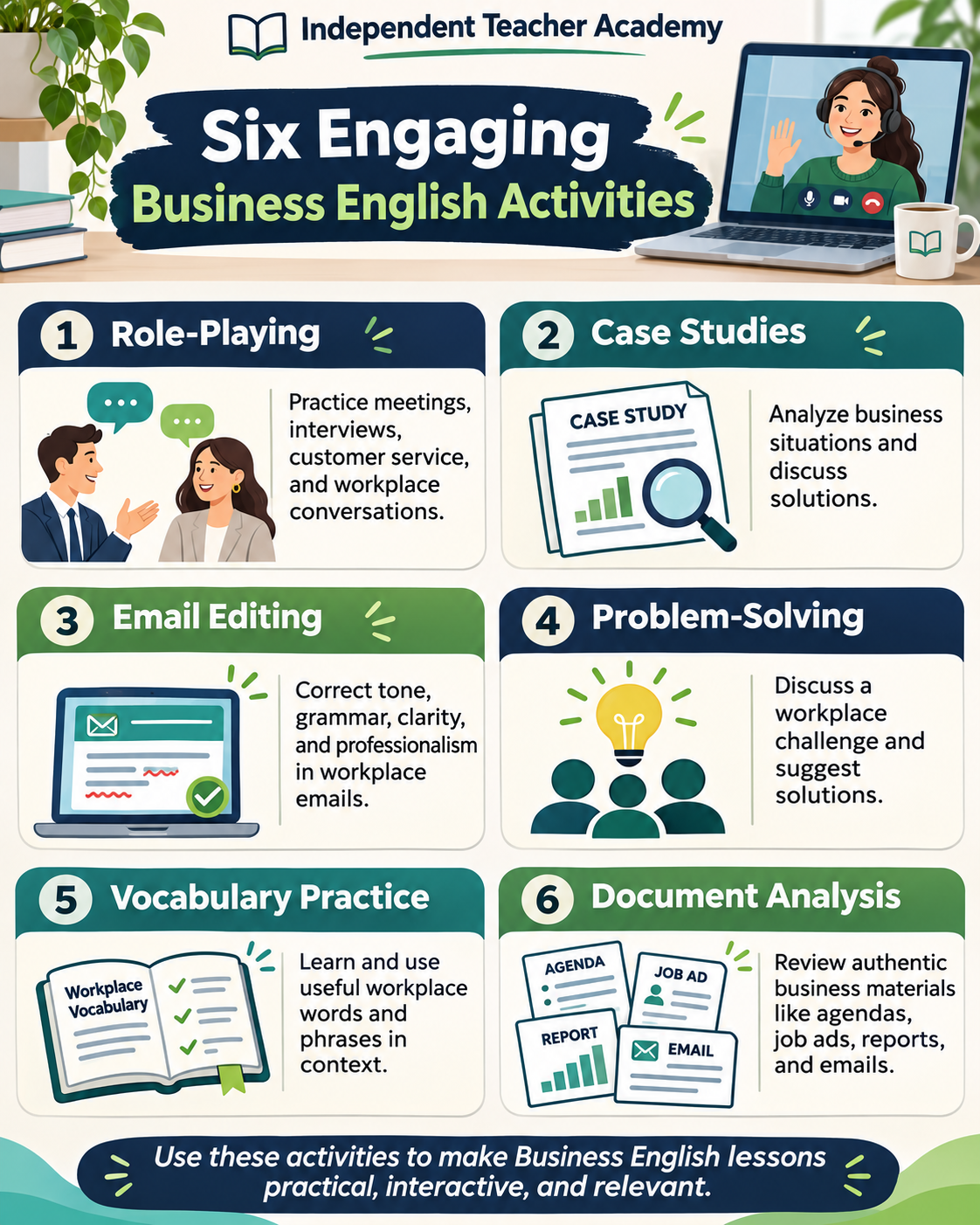
Adults are often investing time and money because they want to perform better at work. Make activities feel like realistic communication rather than disconnected exercises.
Business Role-Playing
Practice customer complaints, deadline extension requests, team meetings, salary discussions, and workplace misunderstandings. Give each person a specific objective.
Real-World Document Analysis
Explore job listings, public company announcements, sample meeting agendas, and professional emails. Avoid confidential documents without permission and proper anonymization.
Problem-Solving Challenges
Give students a workplace scenario, such as a late customer order and a refund request. Ask them to explain options and recommend a response.
Vocabulary in Context
Teach agenda, deadline, stakeholder, action item, and follow-up through a mock meeting rather than an isolated word list.
Error Correction and Email Editing
Have students revise sample emails containing grammar mistakes, unclear wording, or inappropriate tone. Discuss the reasoning behind each revision.
Business Case Studies
Ask students to evaluate a fictional business facing declining sales and propose a plan. Case studies suit intermediate and advanced learners.
Step 4: Structure Your Online Business English Lessons
Focus each class on one measurable outcome. For example: By the end of the lesson, the student will be able to disagree politely in a meeting and support an opinion with two reasons.
Example 60-Minute Business English Lesson Plan
Topic: Expressing opinions in meetings
Level: B1–B2
Objective: Agree, disagree, and explain opinions in workplace discussions.
| Time | Stage | Activity |
|---|---|---|
| 0–5 min | Warm-up | Discuss recent meetings |
| 5–15 min | Vocabulary | Introduce agreement and disagreement phrases |
| 15–25 min | Guided practice | Complete short workplace dialogues |
| 25–40 min | Main activity | Run a meeting simulation |
| 40–50 min | Feedback | Review strengths and errors |
| 50–60 min | Application | Repeat the task and assign follow-up work |
For shorter classes, teach fewer phrases or shorten the simulation without eliminating meaningful speaking practice.
Step 5: Personalize Lessons for Different Industries
An accountant may need to discuss financial reporting, while a technology professional may need to explain a software rollout. You don’t have to be an expert in each industry: your job is to teach the language skills needed for the student’s responsibilities.
| Industry | Useful lesson topics |
|---|---|
| Technology | Project updates, software demonstrations, troubleshooting |
| Marketing | Campaign presentations, research, branding |
| Finance | Budget discussions, reports, forecasts |
| Healthcare Administration | Scheduling and service communication |
| Hospitality | Reservations, customer complaints, service recovery |
| Human Resources | Interviews, feedback, onboarding |
| Sales | Product demonstrations, negotiations, client relationships |
| Entrepreneurship | Networking, pitches, supplier communication |
Step 6: Choose the Right Tools
- Google Docs: collaborative writing, vocabulary lists, and email editing
- Google Slides: presentations, prompts, and role-play situations
- Zoom or Google Meet: video lessons and meeting simulations
- Canva: visually engaging worksheets and teaching materials
- Google Forms: needs analysis and feedback surveys
- Digital whiteboards: brainstorming and mapping workplace conversations
Choose tools that improve practice and teaching efficiency. You don’t need every app available.
Step 7: Give Feedback and Track Progress
Students want to see evidence that their workplace English is improving. Track fluency, professional tone, vocabulary, pronunciation, clarity, and task completion.
At the start of a course, ask a learner to deliver a three-minute presentation. Evaluate organization, transitions, clarity, and responses to questions. Repeat a comparable task later and discuss observable improvements. Confidence ratings are useful, but pair them with actual performance.
Step 8: Find Business English Students Online
Position yourself around the professional results you help students achieve. Compare “I teach English online to adults” with “I help international professionals communicate confidently in English meetings, interviews, and presentations.”
Choose a Target Audience
- Business English for international professionals
- Job interview preparation
- English for entrepreneurs
- Business English for IT professionals
- Workplace communication for intermediate learners
- English presentation coaching
Create Content That Attracts Students
Publish useful articles and videos on job interviews, meeting language, professional email phrases, and workplace English mistakes. Related Independent Teacher Academy resources include 50 content ideas for online teachers and a weekly marketing routine for finding students.
Offer a Structured Learning Program
An example eight-week Business English communication program might cover introductions, networking, professional emails, meetings, problem-solving, presentations, negotiations, and a final simulation. Adapt the program to each student’s goals.
Step 9: How Much Should You Charge?
Business English can support specialized pricing because lessons may require workplace-specific preparation, targeted feedback, and customization. Rates vary with teacher experience, audience, market, lesson length, and service scope. Account for preparation and administration, not just teaching time.
You may offer individual lessons, packages, interview-preparation sessions, presentation coaching, or structured courses. For more on moving toward independent teaching, read How to Transition From Classroom Teaching to Online Teaching.
Common Mistakes to Avoid
- Teaching too much vocabulary: Focus on words students need at work.
- Using identical lessons for everyone: Personalize to level and profession.
- Focusing only on grammar: Teach clarity, tone, listening, and fluency too.
- Ignoring real workplace challenges: Practice spontaneous responses and unfamiliar accents.
- Not measuring progress: Set observable goals and revisit them.
- Overcomplicating materials: A well-designed role-play can be more effective than an elaborate slideshow.
Frequently Asked Questions
Do I need a business degree to teach Business English?
No. A business degree is not generally required for independent Business English instruction, although some employers or corporate clients may require additional qualifications.
Can beginners learn Business English?
Yes. Beginners can practice workplace introductions, simple requests, and basic job vocabulary with level-appropriate tasks.
What’s the best way to teach Business English online?
Start with a needs analysis, set relevant objectives, model useful language, simulate workplace tasks, and provide specific feedback.
What teaching materials do I need?
Slides, professional email examples, dialogue prompts, role-play cards, and carefully chosen authentic materials can all be effective.
Is Business English a good niche?
It can be a valuable specialization for independent teachers who can reach a clear audience and deliver practical professional outcomes.
How long does improvement take?
It depends on starting level, goals, lesson frequency, independent practice, and real-world exposure. Set measurable short-term goals instead of promising a fixed time to fluency.
Final Thoughts: Business English Is About Real Communication
Teaching Business English online isn’t about filling lessons with corporate jargon. It’s about helping people speak up in meetings, write important emails, prepare for interviews, and perform better in situations that matter to them.
When you identify students’ needs and build practical lessons around their goals, you create a learning experience with real value—and a useful specialization within your online teaching business.
Ready to Build Your Own Online Teaching Business?
At Independent Teacher Academy, we help online teachers move beyond simply teaching lessons and start building independent teaching businesses. Explore Enroll and Grow to learn how to find your own students, organize your services, and create a sustainable teaching system.
Post your Comment About This Product