
Introduction
Getting your first five students feels impossible… until suddenly it isn’t. Every independent teacher I’ve ever coached has said the same thing: once those first few students arrive, everything gets easier. Your confidence grows, your schedule starts filling, and you finally see that you can build a real business from teaching online.
And the good news? In 2025, it’s more achievable than ever. Parents are actively searching for online teachers, the demand for personalized learning is growing, and social platforms make it incredibly easy to get in front of the right families.
This post walks you through a simple, clear, step‑by‑step plan you can follow this week to land your first five students—without ads, complicated tech, or feeling salesy.
Choose a Clear Niche
Choosing a niche is the single fastest way to get students—especially your first five. When you tell parents you teach “ESL,” it feels too broad. But when you say you help shy 6–9‑year‑olds speak confidently in English, parents immediately know who you’re for.
A niche helps you:
- Stand out in a crowded market
- Attract parents who are already looking for your exact help
- Charge more because your offer feels specific and valuable
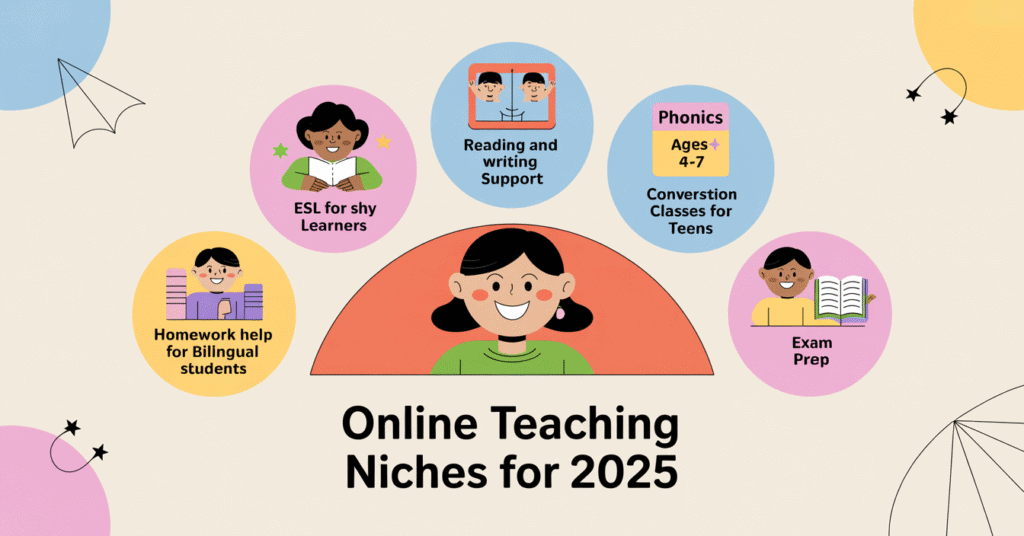
Here are some strong niches in 2025:
- ESL for shy or anxious learners
- ESL reading and writing support (HUGE demand)
- Phonics for ages 4–7
- Conversation classes for tweens and teens
- Homework help for bilingual students in U.S. schools
- Exam prep (IELTS, TOEFL Juniors)
- English for bilingual kids who speak English at home but need formal structure
Quick Exercise to Choose Your Niche Today
Answer these three questions:
- Who do you enjoy teaching the most? (age + personality)
- What problem do you solve really well?
- What results would a parent pay for?
Put it together like this:
“I help [age group] who struggle with [problem] so they can [result].”
This one sentence becomes the foundation for your entire business.
Create a Simple, High-Converting Offer
Your offer is one of the biggest factors in whether parents say yes or keep scrolling. When you’re brand new, your goal isn’t to build a massive curriculum or create the “perfect” lesson plan—it’s to make your offer so clear that parents instantly understand what their child will get.
Keep Your Offer Simple
Parents don’t want complicated bundles or pages of options. They want:
- What you teach
- Who it’s for
- What their child will achieve
- How often lessons are
- How much it costs
A clean, easy-to-understand offer wins every time.
A Beginner-Friendly Offer Template
Here’s a simple structure that converts incredibly well:
“I teach [age group] who struggle with [problem] so they can [specific result], through [number] weekly lessons that are [lesson length] minutes each.”
Example:
“I teach 6–9-year-olds who struggle with speaking confidence so they can communicate clearly in English. We meet once or twice a week for 30 minutes.”
Pricing Guidance for New Independent Teachers
If you’re just starting out and want to get your first students quickly, here are solid starting points:
- $20–$35 per 25–30 minute lesson for beginners
- $35–$50 if you have strong experience or a specialized niche
You can (and should) raise prices once you’re consistently booked.
What to Include in Your Offer
- A clear description of the outcome
- Lesson frequency + length
- A simple trial lesson option
- A short explanation of how you teach (games, conversation, writing, etc.)
What to Skip for Now
Do NOT spend time on:
- Building an entire curriculum before you have students
- Offering 7 different package options
- Creating a giant “program” with modules and PDFs
- Writing a 10-page parent handbook
Your very first offer just needs to be clear, simple, and easy for parents to say yes to.
Set Up the Minimum Tech You Need
You do not need a website, a funnel, or a complicated booking system to get your first five students. In fact, those things slow teachers down. Your tech setup should be simple, quick, and focused on helping parents book with you easily.
The Only Tech You Need to Start
Here’s the bare minimum to get up and running this week:
- A messaging platform (WeChat, WhatsApp, or Facebook Messenger)
- A scheduling link for trial lessons
- A way to collect payments
- A meeting platform (Zoom or ClassIn)
That’s all. Anything else is optional.
Recommended Tools (Free or Low-Cost)
- Calendly (Free) – parents can book trials without messaging back and forth.
- Zoom (Free) – reliable, familiar to parents, easy to use.
- ClassIn – a classroom-style teaching platform some teachers prefer.
- Koala Go – my favorite interactive classroom platform for online teachers; fun, student‑friendly, and built for engagement.
- Stripe or PayPal – simple payment collection.
- Google Drive or Canva – for homework or quick resources** – for homework or quick resources.
These tools cover everything you need to teach your first lessons.
What NOT to Build Right Now
Skip anything that eats up time but doesn’t bring you closer to your first five students:
- Building a full website
- Setting up email automation
- Designing a whole curriculum
- Creating fancy slide decks for every lesson
- Making a big parent handbook
Focus on getting visible, booking trials, and converting those students. The rest can come later—after the income starts coming in.
Get Visible Where Parents Already Are
Getting your first students starts with putting yourself where parents are already spending time. You don’t need to do every platform—just choose one or two that match the age group and type of parents you want to reach.

Best Platforms in 2025 for Getting Seen Fast
Facebook – still the strongest platform for parents of young learners. Mom groups, local groups, parenting communities, and learning support groups are packed with families actively looking for tutors.
WeChat – essential if you work with Chinese learners. Parents rely heavily on teacher recommendations, Moments posts, and shareable content.
Instagram – great for showcasing your personality through Reels, carousels, and daily stories.
YouTube Shorts – growing fast; even simple educational tips can attract parents searching for help.
Pick one to focus on for the first 30 days.
How to Create Posts Parents Actually Respond To
Parents stop scrolling for content that:
- Shows your teaching style
- Demonstrates how you help children
- Gives tips that solve real problems
- Includes simple stories from your lessons
- Shows confidence, personality, and compassion
These types of posts perform especially well:
- A quick English tip for kids
- A student success story
- A “before and after” confidence story
- A short clip of you explaining something simply
- A parent-facing tip (“3 ways to help your child speak more confidently at home”)
You don’t need to go viral—you just need to be visible.
Why Personal Storytelling Works So Well
Parents hire people, not companies. When they see:
- Your journey as a teacher
- Why you teach the age group you do
- How you help nervous or shy learners
- Your teaching philosophy
…they immediately feel more connected to you.
A simple storytelling post can do more for your business than a month of generic ESL tips.
Use the 3-Part Outreach Strategy
Outreach isn’t spammy when it’s done with intention. You’re not cold‑DMing random parents—you’re connecting with people who either already know you, already need help, or are open to learning from you. This simple 3‑part strategy is one of the fastest ways to get your first five students.
1. Warm Outreach
These are people who already know you:
- Friends
- Old coworkers
- Former parents or students
- People who follow you on social media
Send a friendly, low‑pressure message such as:
“Hey! I just opened a few spots for online English lessons for kids ages ___. If you know anyone who might need support, can you send them my way? No pressure at all—just wanted to share.”
Warm outreach often brings your very first student.
2. Neutral Outreach
These are communities you’re already active in:
- Facebook groups
- Local community groups
- Parenting groups
- Teaching groups where parents ask for tutor recommendations
Your goal here is to show up consistently by:
- Answering parent questions
- Giving helpful, simple advice
- Posting educational value once or twice a week
Neutral outreach works because parents see you being helpful—not promotional.
3. Incentive Outreach
This is where you offer something valuable that naturally leads parents to book a trial:
- A free mini‑lesson
- A downloadable worksheet
- A pronunciation guide
- A confidence checklist
- A 15‑minute speaking assessment
Pair the freebie with a simple call‑to‑action like:
“If you’d like me to give your child a custom speaking assessment, just message me the word ‘ASSESSMENT.’”
Exactly What to Say During Outreach
Keep it short, warm, and parent‑focused:
“If your child needs help with [problem], I’d love to support them. I have availability this week for trial lessons—just message me the word TRIAL and I’ll send you the details!”
Use the script that feels natural to you, and send it to anyone who shows interest.
Turn Trials Into Paying Students
Getting trials is step one—turning them into paying students is where your business really starts moving. The good news? With a simple structure, most teachers see 60–80% conversion, meaning you only need a handful of trials to get your first five students.
How Many Trials You Need
Most independent teachers convert 3 out of 5 trial lessons.
So to get your first 5 paying students, aim for:
- 6–10 trial lessons total
This is absolutely doable within your first week or two if you follow the outreach plan.
A Trial Lesson Structure That Converts
Parents are not hiring you based on content—they hire based on how confident, happy, and supported their child feels with you.
Here’s the simple structure:
- Warm Welcome (1–2 minutes)
Greet the child by name, smile, use a fun prop or question. - Mini Activity (5 minutes)
Something engaging and age-appropriate—phonics, vocabulary, or a speaking game. - Skill Demonstration (5 minutes)
Show how you help the child improve. Give one tiny correction or tip. - Confidence Moment (3 minutes)
End with an activity the child can do successfully to feel proud. - Parent Recap (2 minutes)
Tell the parent what their child did well and what you can help them improve.
This structure builds trust, shows value, and makes the parent feel like you already know how to help their child.
Follow‑Up Scripts That Get Yes Responses
Parents often need a quick nudge. After the trial, send this:
“Thank you so much for today! [Child’s Name] did an awesome job with ____. I’d love to support them in improving ____. I have availability on ___ or ___. Which works best for you?”
If they don’t respond within 24 hours:
“Hi! Just checking in 😊 I’d love to save a spot for [Child’s Name]. Let me know if you have any questions!”
Most parents appreciate the follow‑up, and it often converts the sale.
Keep Momentum After Your First 5
Landing your first five students is the breakthrough moment—and once you’re here, things get easier and faster. Now your job is to keep the momentum going so you can continue filling your schedule and raising your confidence as a business owner.
Snowball Your Growth
Your current students are your best marketing. Use what’s already working:
- Share small wins or progress stories (no names needed)
- Ask parents if they have friends who might need support
- Stay active on the platform where you first found success
- Keep posting consistent, helpful, parent‑focused content
Consistency compounds—your visibility grows, your confidence grows, and more parents start reaching out.
When to Raise Your Rates
A good rule of thumb:
- When you reach 8–10 paying students, raise your prices for new students only.
- When you have a waitlist, raise your rates again.
Small increases at the right time make a big difference in your monthly income.
When to Start Group Classes
Once your schedule is getting full or you’re feeling tapped out, group classes are the next step. Start considering groups if:
- You consistently get inquiries for the same age group
- Parents ask for a lower‑cost option
- You want to increase your hourly income without adding more teaching hours
Even one group class can double or triple your income from the same time block.
Conclusion
Getting your first five online students is the hardest part—because it’s the start. But once you follow this plan, get visible, book those trial lessons, and start helping real kids, everything shifts. Your confidence grows, parents start referring you, and you finally feel the momentum you’ve been waiting for.
And if you want the step‑by‑step system that has helped teachers get fully booked in just a few weeks, I’d love to invite you to join Teacher Boss Society. Inside, you’ll get instant access to the Enroll and Grow Challenge, where I walk you through:
- The exact outreach scripts to use
- How to structure high‑converting trial lessons
- How to find your first 5 (or next 5!) students using social media
- The real strategies teachers are using to fill their schedules fast
If you’re serious about getting students now, this is the support you need.
👉 Join here: https://www.skool.com/teacher-boss-society-3521/about
You don’t have to do this alone. You can start today—and your first 5 students are absolutely within reach.
Leave a Reply